
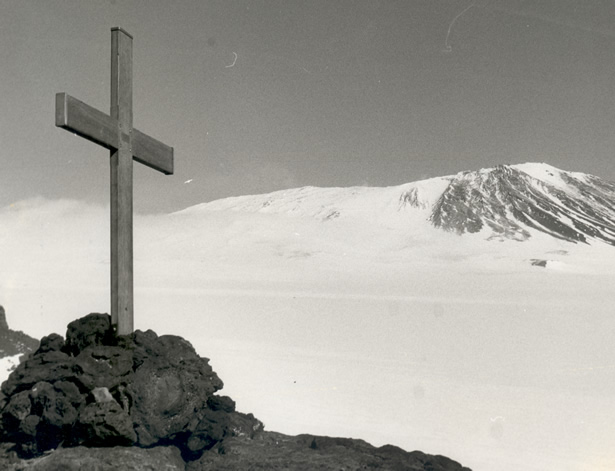
On the morning of 28 November 1979, Air New Zealand Flight TE901 left Māngere airport, Auckland, for an 11-hour return sightseeing flight to Antarctica. At 12.49 p.m. NZST, the aircraft crashed into the lower slopes of Mt Erebus killing all 237 passengers and 20 crew on board. It was the worst civil disaster in New Zealand's history.
Search and rescue aircraft in Antarctica were activated and at midnight (NZST) wreckage was sighted on the lower slopes of Mt Erebus. Final confirmation that there were no survivors came later the next day.
Mt Erebus
Mt Erebus, on Ross Island near Antarctica, is the southernmost active volcano on Earth. At 3,794 metres, it is marginally higher than Aoraki/Mt Cook. It was discovered on 27 January 1841 during Sir James Clark Ross’ Antarctic expedition, and named after one of his ships, HMS Erebus. In Greek mythology, Erebus is the personification of darkness. It was one of the first five beings in existence, born of Chaos, the void state preceding the creation of the universe (the cosmos).
Professionals and volunteers from Antarctica and New Zealand took part in difficult and often harrowing investigative, recovery and identification operations.
Debate raged over who was at fault for the accident. While the chief inspector of air accidents attributed the disaster to pilot error, Justice Peter Mahon’s Royal Commission of Inquiry placed the blame on Air New Zealand and its systems. The controversy continues.
The Erebus disaster has been remembered in many ways. Memorial services for the victims were held in the immediate aftermath of the crash, and on significant anniversaries. An enduring home for a National Erebus Memorial in Aotearoa New Zealand is currently being explored.
At an event to mark the 40th anniversary of the disaster the Prime Minister, Jacinda Ardern, and the chair of Air New Zealand, delivered an apology.


