
A timeline of crime: May–June 1866
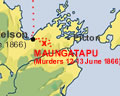
In May 1866 the Burgess gang embarked on a crime spree on the west coast of the South Island that would culminate in the murder of five men on the Maungatapu Track.
May:
Hokitika
On 10 May Burgess stole two revolvers from the Hokitika police camp, then 'discovered' the weapons at a nearby beach in the presence of two witnesses, Sullivan and a man named Chamberlain. When the police searched his room and located the firearms, his witnesses helped him escape charges. The police retaliated by giving the Hokitika press details of Burgess’s exploits in Dunedin, and ‘advising’ him and Kelly to leave town.
Greymouth
Burgess, Kelly and Sullivan headed overland for Greymouth on 24 May, while Levy left separately on the steamer Wallaby. A plan was hatched to rob a gold buyer, Edward Fox, at Greymouth. Levy would receive the proceeds, then the others would join him on the Wallaby and travel to the Buller River (Westport).
Their plans were disrupted when they found that Inspector James, formerly of Hokitika, had been transferred to Greymouth. Burgess, Kelly and Sullivan decided to evade surveillance by crossing the Grey River to Cobden in Nelson province. After a drinking binge, they re-crossed the river on 28 May and murdered George Dobson, a surveyor whom they mistook for Fox. Dobson had helped explore suitable routes between Canterbury and the West Coast – Arthur's Pass is named after his brother.
Undeterred, the gang set up an ambush of the real Fox on 31 May. They were again thwarted by the police, who provided the gold buyer with an armed escort disguised as miners. Burgess and his associates recognised the constables and remained in hiding as the party travelled past. Unaware of Dobson's death and unable to prove they had planned a robbery, Inspector James gave the gang 48 hours to leave town.
June:
Buller River
Using assumed names, Burgess, Sullivan and Kelly rejoined Levy aboard the Wallaby on 2 June and departed for Westport with plans to rob the bank there. Finding that it had closed, they continued on to Nelson.
Nelson
Arriving in Nelson nearly penniless on 6 June, the gang considered robbing one of the town's three banks, but found the police presence too great. Instead, they decided to walk the 70 miles to Picton and try their luck there. They left on 7 June via the rugged Maungatapu Track, which would take them past the Wakamarina goldfield.
On 10 June they arrived at the goldfields settlement of Canvas Town, 40 miles short of Picton, and persuaded a local storekeeper, George Jervis, to let them stay in an empty hut. Levy set about finding a possible target for the gang. At nearby Deep Creek, he met Felix Mathieu, a publican and storekeeper, whom he had met before in Otago. Mathieu and three associates, James Dudley, John Kempthorne and James de Pontius, were about to leave for the West Coast, carrying money and gold. When Levy informed the others, plans were made to ambush the travellers near the summit of the Maungatapu Track.
The gang left Canvas Town early on 12 June and were passed on the track by James Battle. Burgess and Sullivan, concerned about potential witnesses, attacked Battle. After robbing him of £3, they throttled him and buried him in a shallow grave. The gang camped overnight at Franklyn's Flat while they waited for their intended prey.
Blood-stained gold
‘Gold of course was at the bottom of it, but the canvas-bags full of the glittering flakes were red with blood by the time they reached the bank at Nelson.’
Lady Barker, Station Amusements in New Zealand, William Hunt & Co., London, 1873
The Mathieu party was attacked at around 1 p.m. on 13 June. The men were killed one by one: Dudley was strangled, Kempthorne and de Pontius were shot, and Mathieu was both shot and stabbed. The gang acquired cash and gold dust worth £320 (nearly $35,000 in today's money). The party's packhorse was led away to a gully and shot, and de Pontius was buried to make it look as if he had murdered his companions and fled.
The gang continued on to Nelson, where they arrived that evening, booking into different hotels under false names.
Next day they sold the gold and divided the proceeds equally before deciding to lie low for seven days, then travel to New Plymouth by ship.
Unbeknown to the gang, a friend of Mathieu's, Henry Moller, had followed his party with the intention of retrieving their packhorse in Nelson. Surprised not to have caught up with them on the track, he suspected foul play when they failed to arrive in Nelson. On 15 June he reported their disappearance to police, then rode back to Canvas Town. There, George Jervis described his encounter with Levy and his colleagues. Levy in particular was remembered because he had been seen in both Canvas Town and Deep Creek. Moller and Jervis informed Police Sergeant Goodall at Deep Creek of their fears for the Mathieu party.
Goodall and Jervis rode to Nelson on 17 June to tell Sergeant-Major Shallcrass that the missing men had probably been murdered. When a search party found some evidence of a crime, Levy was arrested. On 19 June his three associates were located and arrested under the names of Miller, Noon and McGee.


