
For New Zealand, 1953 had been a year of significant milestones. In May, Edmund Hillary had scaled the heights of Mt Everest. On 23 December the country could barely control its excitement at the arrival of the beautiful young Queen Elizabeth II and her dashing husband, Prince Philip.
Disaster timeline
3 p.m., 24 Dec – Train leaves Wellington for Auckland
8.02 p.m. – Rim of Ruapehu’s crater lake gives way, releasing the lahar
10.09 p.m. – Train leaves Waiōuru railway station
~10.10-10.15 p.m. – Lahar reaches bridge and washes away pier 4
10.20 p.m. – Train passes through Tangiwai railway station
10.21 p.m. – Train crosses bridge, which collapses
10.30 p.m. – Car Z falls into river and is swept downstream
10.35 p.m. – Lahar flow has substantially subsided
Midnight – Survivors start arriving at Waiouru Camp Hospital
4 a.m., 25 Dec – Recovered bodies start to arrive at hospital
Morning of 25 Dec – PM Holland rushes to Waiōuru and announces tragedy via radio
9 p.m., 25 Dec – Queen gives Christmas broadcast finishing with message of sympathy
31 Dec – Prince Philip attends state funeral for 21 unidentified victims
All of this changed on Christmas Day, when Prime Minister Sidney Holland announced with ‘profound regret’ news of the accident in a radio broadcast from the military camp at Waiōuru. With no newspapers published on Christmas Day, this was the first many New Zealanders heard of the tragic events of the previous evening.
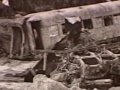
The weather on Christmas Eve was fine and with little recent rain, no one suspected flooding in the Whangaehu River. When a goods train crossed the bridge around 7 p.m. the river appeared normal. What transformed the situation was the sudden release of approximately 2 million cubic metres of water from the crater lake of nearby Mt Ruapehu. A 6-metre-high wave containing water, ice, mud and rocks surged, tsunami-like, down the Whangaehu River. Sometime between 10.10 and 10.15 p.m. this lahar struck the concrete pylons of the Tangiwai railway bridge.
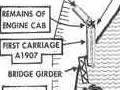
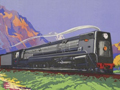
Travelling at approximately 65 km per hour, locomotive Ka 949 and its train of nine carriages and two vans reached the severely weakened bridge at 10.21 p.m. As the bridge buckled beneath its weight, the engine plunged into the river, taking all five second-class carriages with it. The force of the torrent destroyed four of these carriages – those inside had little chance of survival.
The leading first-class carriage, Car Z, teetered on the edge of the ruined bridge for a few minutes before breaking free from the remaining three carriages and toppling into the river. It rolled downstream before coming to rest on a bank as the water level fell. Remarkably, 21 of the 22 passengers in this carriage survived. Evidence suggested that the locomotive driver, Charles Parker, had applied the emergency brakes some 200 m from the bridge, an action which prevented the last three carriages from ending up in the river and saved many lives.
Lahars on the mountain
Lahars are a recurring natural event associated with Mt Ruapehu. In the investigation that followed the 1953 tragedy, it was discovered that a lahar had substantially weakened the rail bridge at Tangiwai in 1925. A warning from amateur geologists that the state of the crater wall was a reason for concern had largely been ignored by the authorities. In 1954 a board of inquiry assisted by James Healy, the superintending geologist at the Geological Survey, DSIR, concluded that no one was to blame for the disaster. The police found no evidence that legal blame could be attached to any party, and there were no prosecutions.
The board recommended the installation of an early warning system upstream on the Whangaehu River. A moderate-sized lahar that flowed down the river in March 2007 caused little damage and no injuries, thanks to a sophisticated monitoring and alarm system.


