
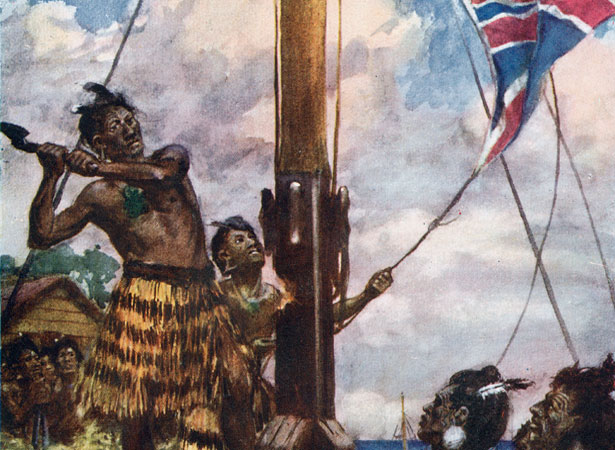
The first Māori to sign the Treaty of Waitangi, Ngāpuhi chief Hōne Heke Pōkai soon became disenchanted with the consequences of colonisation. He expressed his outrage by repeatedly attacking the flagstaff on the hill above Kororāreka (Russell).
Hōne Heke chopping down the British flag is an enduring image in New Zealand history. Traditional Pākehā interpretations portrayed him as a ‘rebel’ who was finally subdued by ‘good Governor’ George Grey. In reality, questions of authority in the north remained unresolved well after 1840, years in which the Bay of Islands also lost its political and economic importance.
Te Haratua, Heke’s right-hand man, first attacked the flagstaff in July 1844. The British re-erected it, but it was levelled twice in January 1845. A fourth attack on the flagstaff on 11 March signalled the outbreak of war in the north.
The ‘Flagstaff War’ was no simple matter of Māori versus British – two Ngāpuhi factions squared off against each other. Heke and Kawiti fought both the Crown and Ngāpuhi led by Tāmati Wāka Nene. The fighting ended in a stalemate in January 1846 (see 11 January).
Read more on NZHistory
Kororāreka – A frontier of chaos?Treaty events 1800-49 – Treaty timelineHōne HekeOrigins of the Northern War – The Northern WarRussell - roadside stories – A frontier of chaos?Hōne Wiremu Heke Pōkai
External links
How to cite this page
'Hōne Heke cuts down the British flagstaff - again', URL: https://nzhistory.govt.nz/hone-heke-cuts-down-british-flagstaff-for-a-third-time, (Ministry for Culture and Heritage), updated 24-Sep-2020


