
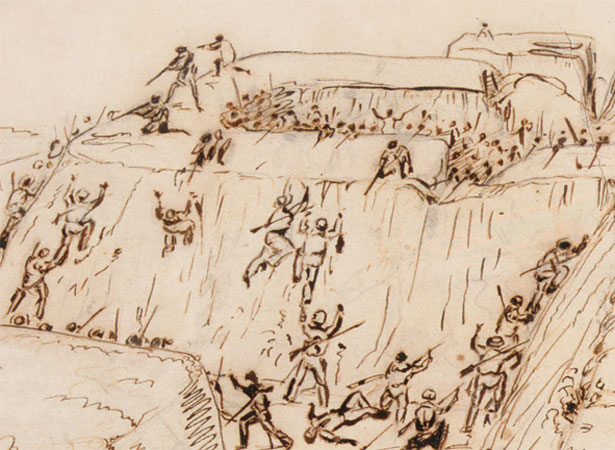
More British soldiers and sailors were killed at ‘Bloody Rangiriri’ than in any other battle of the New Zealand Wars, but their eventual hard-fought victory opened the Waikato basin to the advancing imperial forces.
Following the invasion of Waikato (see 12 July), Māori defended a strong pā at Meremere for several months. They also began building a second defensive line across a narrow strip of land between the Waikato River and Lake Waikare, 10 km upstream.
The central redoubt, the work of the chief Te Wharepū, was a carefully hidden trap with concealed firing positions. But the formidable fortification was incomplete. It was also undermanned, with only about 500 fighters present, one-third of the British strength. The prolonged defence of Meremere had stretched the human and economic resources of the Kīngitanga – and it was now planting season, when fighting traditionally paused.
The British were under no such constraints. On the afternoon of the 20th, artillery bombarded the pā, hundreds of imperial troops were landed by boat behind the Māori lines, and the outlying earthworks were cleared. The central position remained unbreached despite repeated frontal assaults. Forty-seven British and 35 Māori were killed in a few hours.
At daybreak next morning the 180 Māori still in the pā raised a white flag in an attempt to negotiate. Instead, the British took them prisoner. The captives were marched to Auckland and later held on Kawau Island, from where they escaped to the mainland on the night of 11 September 1864. They entrenched themselves on a ridge overlooking Omaha and Matakana, and scoffed at suggestions they give themselves up.
In the words of the historian James Cowan, ‘the Government wisely left them alone, and they presently made their way across to the Kaipara, and thence to West Waikato.’
Read more on NZHistory
Taranaki and Waikato wars – New Zealand's 19th-century warsRangiriri NZ Wars cemetery arch – Memorials registerRangiriri NZ Wars army memorial – Memorials registerRangiriri – War in WaikatoRangiriri pā - roadside stories – War in WaikatoRangiriri – 100 New Zealand Places
External links
How to cite this page
'British capture Rangiriri', URL: https://nzhistory.govt.nz/maori-surrender-at-rangiriri, (Ministry for Culture and Heritage), updated 21-Nov-2023


