
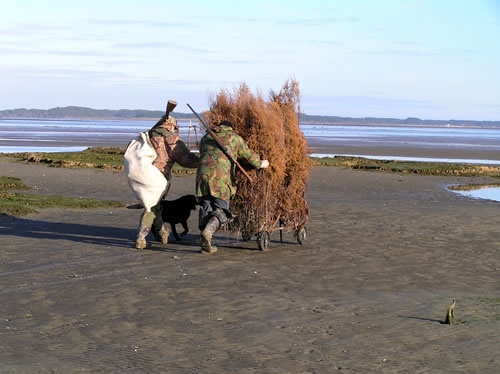
The push-out mobile hide is one solution to the problem posed by the tidal flats of this estuary near Invercargill. Greg Blomfield's family have been hunting there since the 1940s and have 'a trump card' for dealing with low water – a manuka-thatched metal frame with a suspended plank for the hunter to sit on. Add plastic wheels and some steady pushing from determined hunters and you have achieved step one of the six steps to successful wildfowling: 'Go where the birds are.'
Out for a duck
Duck hunting for many brings to mind family stories of uncles working on their mai mais in the lead-up to opening day, only to get drunk on whisky and fail to fire a shot on opening morning. Mixing alcohol and weapons is frowned upon by modern hunters, who are more safety-conscious than their forebears. Contemporary duck hunters also use non-toxic shot (it used to be lead), as hunter Gary Girvan explains in his book Duck hunting in New Zealand (David Bateman, 2007).
Most duck hunters only shoot on opening day, but the dedicated hunt throughout the autumn season. Gary Girvan is one such hunter and his book outlines how to be a successful duck shooter. It builds on a surprisingly sparse New Zealand duck-hunting literature. Most duck-hunting books are how-to guide books with some anecdotes thrown in.
Compare this with the wealth of trout-fishing and deer-hunting books, which are filled with stories and anecdotes from the backcountry and riverbank. Purportedly these are non-fiction. Auckland's Halcyon Press is a major publisher of fishing and hunting tomes and many other publishing companies exploited the a market for outdoor tales. In fiction Barry Crump's novels A good keen man (1960) and Wild pork and watercress (1986) have mythologised deer and pig hunting. A good keen man is one of New Zealand's top-selling books, amassing sales of 400,000 by 1992.
Some 30,000 Kiwis from all walks of life (mainly men) purchase a game-bird hunting licence each year. Duck shooters flock to ponds, lakes, swamps and rivers to enjoy the annual ritual of opening morning – the first Saturday in May. Girvan's book provides advice for successful hunting, recounts the social history of the sport, explores the environment in which it takes place and explains the behaviour of birds in the wild.
He notes in his preface that writing a book enabled him to justify the travel and expense required to meet all types of contemporary duck hunters – and he could even 'call it work!'
By Dinah Vincent and Carl Walrond
Further information
- Duck shooting (Te Ara)


Community contributions