
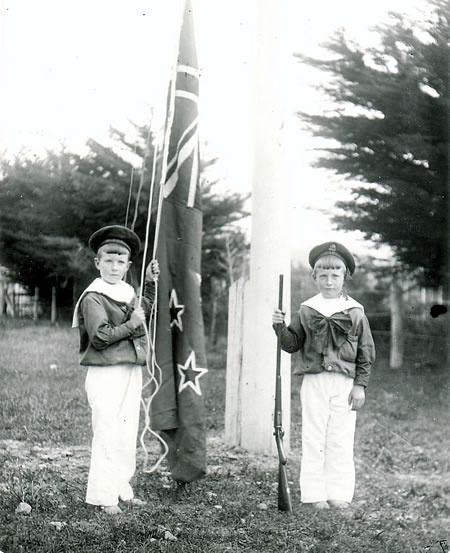
Jack and Rewi Moynihan unfurling the flag, Shannon School, 1901.
Flags in schools
In the late 19th and early 20th centuries there was considerable public and government support for flag-raising ceremonies in schools. Regulations introduced during the Second World War to dictate when and how schools held ceremonies to honour the flag also seem to have had wide support. But plans a few decades later to reinvigorate these regulations and make daily flag-raising in schools compulsory aroused great debate. School flagpoles were even chopped down in protest.
19th and early 20th century
In the late 19th century the use of the flag to promote patriotic and imperial ideals was advocated. As one member of the House of Representatives put it, to know the history of the flag was to 'have his heart warmed and his national feeling quickened, and be fired with love and affection for his flag'. Letters to the newspapers called on the government and Education Boards to instil respect for the flag in children through flag-raising ceremonies that would heighten a sense of national identity and pride.
The government initially responded by making occasional gifts of flags to schools. During the fervour of the South African War, when 'more flags were carried and paraded than there ever had been before', the government extended its commitment by calling for tenders to supply schools with flags. With the support of successive Governors and Governors-General, patriotic societies such as the Navy League and the Victoria League also encouraged the use of the flag in schools. The Navy League made regular presentations of Union Jacks to schools from the early 1900s, and Governors-General continued to oversee the donation of flags to schools by other organisations well into the 1940s.
The increasing popularity of saluting the flag in schools prompted the New Zealand Journal of Education in 1903 to issue rules for 'flag drills' to be undertaken by primary schoolchildren marching in formation. These ceremonies were designed to encourage children to appreciate the honour of the flag, and by association, New Zealand's role in the British Empire. Weekly ceremonies to salute the flag became compulsory in all state schools in 1921. Both the Union Jack and the New Zealand Flag were used in school ceremonies, suggesting that patriotism focused on ideas of Empire rather than a distinct New Zealand identity.
Second World War
During the Second World War the Labour Minister of Education, H.G.R. Mason, introduced regulations on honouring the flag in schools. These regulations were needed because some education boards had bylaws relating to the saluting of the flag that went beyond their powers.
The Ceremony of Honouring the Flag Regulations 1941 came into force in November 1941. They required state schools to 'observe the ceremony of honouring the flag' to commemorate a number of days. Some of these days, such as Waitangi Day and Anzac Day, are still commemorated today, while others like Empire Day and Dominion Day are no longer observed.
1980s revival
In the late 1970s and early 1980s, National Party ministers announced various schemes to 'rekindle national pride'. These included making flags available to the public at a reasonable cost, and ceremonies honouring the flag in schools. In 1981 the ministerial vehicle fleet was allocated small national flags to be flown 'on any occasion when a Minister is travelling to Parliament or to official business'. Prime Minister Rob Muldoon was the first to travel under the national flag. By this time the regulations relating to school ceremonies were not enforced, though many schools continued to hoist their flags on key dates.
In early 1984, Minister of Education Merv Wellington announced that it would be compulsory for all state primary, intermediate, area and secondary schools to fly the flag daily from the beginning of the next school year. As the 1941 regulations still stood, this was ‘not so much a new policy as an updating of an old regulation'.
‘Sexist ritual’
A spokesperson for the Women's Action Group, Di Cleary, declared that flying the flag in school was a 'blatantly sexist phallic ritual'. She demanded that the Minister of Education 'give an immediate explanation of why he is introducing phallus worship into the core curriculum, while continuing to ignore public demand for sex education'.
There were other critics. Some questioned the need for such an activity to be made compulsory. Labour Party education spokesperson Russell Marshall argued: ‘If it was left up to individual schools I think I could accept that, but making it compulsory indicates a pretty strange set of priorities.’
Representatives of Education Boards also expressed concern. The Minister had estimated the cost of supplying new flags and flagpoles at $340,000, with Boards expected to meet their share from existing funds. In the months that followed, the costs mounted as some people protested against the plan by chopping down school flagpoles.
The minister went ahead despite the opposition. In May, a circular outlining the procedures for honouring the flag was distributed to schools. But the plan got no further after Labour won a snap election in July. In October Russell Marshall, now the Minister of Education, announced that the compulsory flag-raising plan had been dropped, as in his view this should be ‘purely voluntary'. Marshall also revoked the 1941 regulations.
Further information
- Henry Mason (DNZB)
- Merv Wellington (Wikipedia)
- Russell Marshall (Wikipedia)


Community contributions