
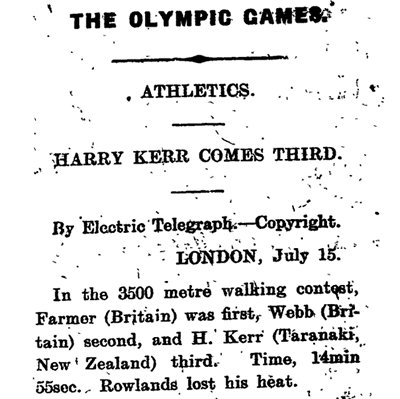
Compare this article about our first Olympic medal which appeared in the Taranaki Herald on 16 July 1908 with TVNZ's Olympics page for the 2012 London Games to see how much has changed in 100 years of media coverage.
Covering the Games
Today when our athletes perform at the Olympics we can follow up-to-the-minute coverage via radio, television or the internet. If they are successful their faces are plastered across newspapers and magazines, and their winning moment is shown repeatedly on television and websites. Back in 1908, when New Zealander Harry Kerr won our first medal, the first most New Zealanders heard about it was probably from a newspaper a day or more after the event. Coverage in the Taranaki Herald - in Kerr's home region - was brief and unassuming.
In the 1930s newspaper coverage was supplemented by radio broadcasts. By the time of the 1932 Los Angeles Olympics, New Zealander Nola Luxford had forged a successful broadcasting career in the United States. She persuaded KFI, an NBC radio affiliate in Los Angeles, that she should broadcast Olympic reports to Australasia. Her one-hour broadcasts were picked up by the YA network in New Zealand and relayed around the country.
Relayed radio coverage of the Olympics was still the norm in New Zealand in 1952. There was no Nola Luxford in Helsinki, but amateur radio operators monitored shortwave broadcasts from Britain, Australia, the United States and Finland. They successfully broadcast news of Yvette Williams' progress in the long jump through the night. By this time the New Zealand Broadcasting Service (NZBS) was also providing bulletins to the stations it controlled. It received up to 170 news bulletins from around the world but still struggled to find out how New Zealanders had performed, because each country generally focused on its own athletes' efforts.
In Melbourne in 1956 NZBS sent its first team of commentators to the Olympics, but its small size caused difficulties at these and following Games. The broadcasters recalled performing their own athletic feats: racing from one venue to the next, switching from one sport to another, and trying to be in the right place at the right time.
A bloody shambles
Keith Quinn recalls covering the opening ceremony of the Montreal Olympics: 'The whole day turned out to be a bloody shambles, what with the New Zealand role in the boycott and the cocked-up sound gear'.
Keith Quinn, Memories of Montreal (TVNZ)
New Zealand's first official television broadcast took place in 1960, but newspapers and radio dominated Olympic reporting into the 1970s. When Olympic coverage first appeared on television in 1964 it was limited to a half-hour programme made up of film shot by an international pool. Television New Zealand (TVNZ) presented the first live television coverage of the Olympics from Montreal via satellite in 1976. Only the opening and closing ceremonies, and events in which New Zealand stood a good chance of gaining medals, were presented live. Technical problems beset the live broadcast of the opening ceremony and much of Keith Quinn's commentary was delivered by Phillip Leishman back in the Wellington Studio.
TVNZ faced further problems in 1980. Following the boycott of the Moscow Olympics it opted out of its original contract and tried to renegotiate for ‘reduced coverage for reduced cost'. It took time to work out a new deal and for the first few days coverage was restricted to a maximum of two minutes per news bulletin.
By the 1984 Los Angeles Olympics TVNZ was delivering coverage throughout the day, with many events broadcast live. Media coverage of the Beijing Olympics delivered an overwhelming amount of content to New Zealanders, including live television coverage on TV One, TVNZ Sports Extra and two online 'channels'.


Community contributions