
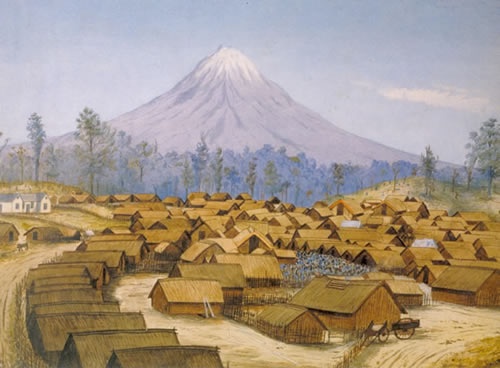
Parihaka, depicted in this painting by George Clarendon Beale (1856–1939), was New Zealand’s largest Maori community in 1881. Its prophets attracted followers from around the country.
Te Whiti-o-Rongomai and Tohu Kākahi had established the pacifist community of Parihaka (formerly Repanga) in the shadow of Mt Taranaki in 1866. During the 1870s Parihaka became the largest Māori settlement in the country.
Tītokowaru had developed a relationship with Te Whiti through his association with Te Ua. This relationship strenghtened through the 1870s. In 1878 the government began surveying the confiscated southern Taranaki lands for European settlement. In May 1879, under the initial direction of Tohu, Parihaka men went out to reclaim this land by ploughing it. Increasingly it was Tītokowaru who saw to the logistics of these protests. He was imprisoned three times.
Tītokowaru’s presence was not lost on the authorities when plans were made to invade Parihaka in November 1881. Native Minister John Bryce took no chances, assembling a force of more than 1500 men. The settlement’s key figures, including Te Whiti, Tohu Kākahi and Tītokowaru, were arrested without resistance. Most of its inhabitants were driven away and Parihaka was largely destroyed. Much of central Taranaki now became Pākehā farmland.


Community contributions