
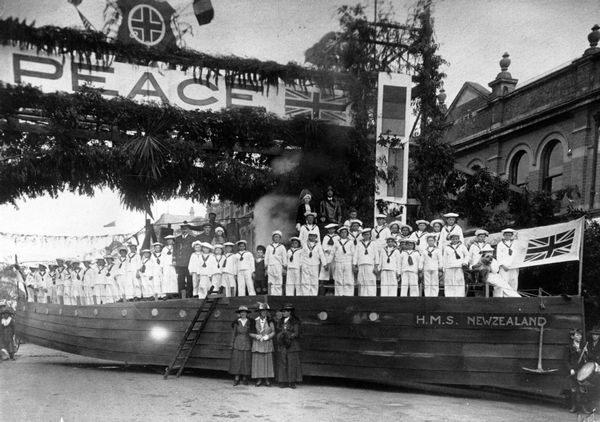
A peace celebration float depicting the battlecruiser HMS New Zealand in front of C.E. Daniell’s shop in Queen Street, Masterton. A large group of children dressed in naval uniform stand on the float. The mock ship was built around a traction engine and took part in parades. It was also photographed on the water after the engine was driven into a river.
Saturday 19 July 1919 – Soldiers’ Day
Most communities celebrated Soldiers’ Day on Saturday the 19th, and where it was marked on another day events usually followed the same format.
The main event was generally a procession along the main street or streets. Most were held in the morning and involved both military and civilians. Auckland’s parade, though particularly large, mirrored those in other communities around the country. It left from the city’s waterfront at 10.30 a.m. and proceeded up Queen Street and on to the Domain. It was led by veterans of previous wars, who were followed by wounded and returned soldiers, and then Territorial and cadet units. As the last of the military section moved off Quay Street East into lower Queen Street, the civic section came in from the western end of the street. This included returned nurses and representatives from patriotic organisations such as the Navy League, societies such as the YWCA, and local government agencies such as the Harbour Board. Bringing up the rear was the trades’ display, which included floats and decorated vehicles from businesses such as the Colonial Ammunition Company.
Visit your dentist for peace
Many businesses tried to capitalise on the peace celebrations, however tenuous their link to them. An advertisement for Auckland dentist J.H. Kinnear's on 19 July 1919 read, 'There can be no perfect peace without perfect teeth'.
The processions weren't the only way businesses got involved. Many companies decorated their buildings elaborately, particularly if they were on the route of a procession. Retailers held sales or encouraged custom by emphasising their patriotic ‘street-cred’, promoting their roll of honour or their commitment to British-made goods.
Auckland and other main centres were able to call on large numbers to participate in their processions, but some of those in smaller communities were no less impressive. Masterton’s procession was more than 1.6 km long. Its floats included large models of a tank, a minesweeper, and HMS New Zealand, the battlecruiser the country had gifted to the Royal Navy.
The processions generally halted before noon. The King’s peace proclamation was read and when noon struck everyone removed their hats for five minutes of silence. On 30 July the Weekly Press described this observance in Cathedral Square, Christchurch:
The hour struck, and every man bared his head. Tram cars and motors ceased running, and a tense silence fell. A furlong or more away a motor horn sounded and seemed to be choked in its desecrating alarm, and then a holy and reverent silence once more fell, till the boom of the first gun of the salute fired in the park carried to the waiting ears. The spirit of the dead seemed to hover round.
In most communities the period of silence was followed by buglers playing the last post. Dunedin went one step further, with buglers stationed at the Town Hall, Knox Church, on Pine Hill Terrace, and in the suburbs of Roslyn, Mornington, St Clair and Andersons Bay.
Some communities, including Christchurch and Dunedin, put on other events in the morning and held their processions in the afternoon. But in most places the afternoon was devoted to sporting activities, ranging from track-and-field events and football matches to more light-hearted activities such as pillow fights. In Strath Taieri, for example, the afternoon’s events included ‘children’s races, returned soldiers’ race, serpentine race, tent pegging, lemon cutting, various races for adults and motor obstacle driving’.
Memorial trees
Several communities planted trees during the celebrations to mark the coming of peace. Some were planted on Soldiers’ Day, as in Hawera; others on Children’s Day, as in New Plymouth, Takapuna and Papakura. On 19 July, ‘Peace Day’ in Manurewa, an entire avenue of trees was planted in Hall Road: 16 in memory of fallen soldiers, one in memory of Nurse Edith Cavell, and one in memory of peace.
As evening fell activities continued in most communities, with dances, torchlight processions, bonfires and fireworks the most popular entertainments. The torchlight processions were somewhat different to those held earlier in the day, with a greater emphasis on music and costumes. They were often followed by massive fireworks displays; Wellington spent more than £400 on fireworks.
The fireworks displays were often preceded or succeeded by a bonfire. In some places a single large bonfire was lit, as on Mt Eden in Auckland. Elsewhere, several were lit at once, including in Dunedin and along the coast of the Bay of Plenty. A memorial marking the latter event was erected later on Mt Maunganui. Burning effigies of the Kaiser on bonfires was popular in the South Island: in Amberley he was ‘blown to pieces’, while in Ellesmere he ‘burnt to a cinder’.
In areas that weren’t dependent on coal for their electricity supply, many buildings were illuminated; touring illuminations was a popular night-time activity. Christchurch, which got its power from a hydroelectric station at Lake Coleridge, had an extensive display. Buildings were lit in red, white and blue and adorned with messages such as ‘Peace with honour, justice and freedom’ (Christchurch Press) and 'All honour to our boys' (Crown Clothing Company). Though the illuminations continued until Children’s Day, the city was ‘absolutely blocked’ with people viewing them on Soldiers’ Day. Because of the coal shortage some centres, like Wellington, had no illuminations. In Auckland no government buildings were illuminated, but the city council had managed to put enough coal aside to light up the Town Hall and the Ferry Building.
Soldiers’ Day was actually a day and night full of activity and entertainment – and for most communities, this was just the first of three days of peace celebrations.


Community contributions