
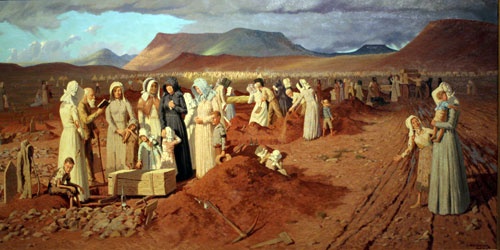
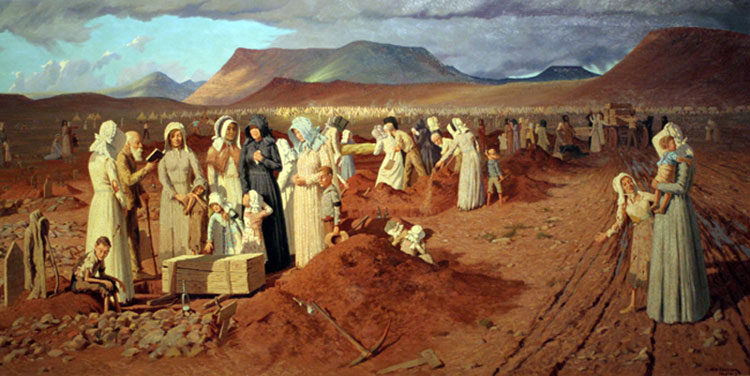
Painting of Boer families burying their dead outside a British concentration camp in South Africa.
Concentration Camps
‘Concentration camps’ were established in South Africa to house Boer families forcibly displaced by Britain's scorched-earth policies. The camps were poorly conceived and managed, and ill-equipped to deal with the large numbers of detainees.
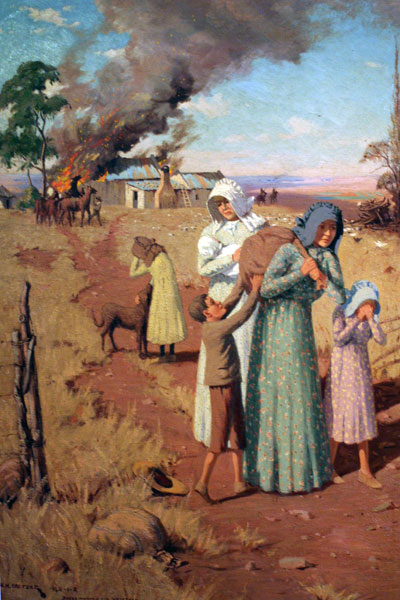
The clearance and destruction of farms by British forces (including New Zealand troops) was intended to remove the main source of support for the Boer commandos. As a result, women and children were left without shelter, food or protection from local tribespeople who the British had encouraged to settle old scores with the Boers. Camps were hurriedly constructed to house them.
At least 40 concentration camps were constructed, holding in all some 150,000 Boer refugees. Some, such as Merebank near Durban, which housed more than 9000 internees, resembled small towns. Another 60 camps were constructed to house the 115,000 native Africans who had worked as servants for the Boers.
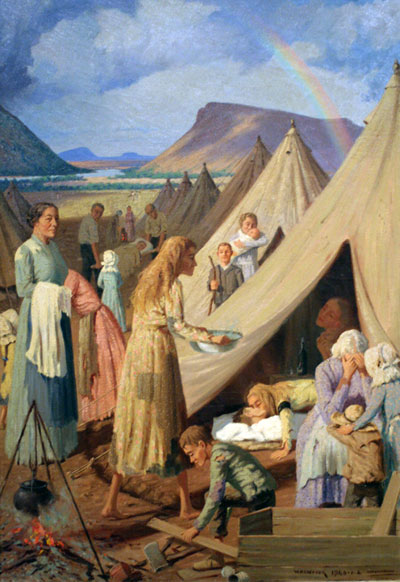
Due to their hasty conception and the difficulties of accommodating a displaced population, the camps offered the bare minimum in terms of housing and supplies, with many internees forced to live in tents. There were two scales of rations – less for those whose menfolk were still fighting. Overcrowding and unsanitary conditions soon led to outbreaks of disease, with typhoid, malaria, measles and dysentery becoming rife. Many British doctors and colonial nurses were shocked by the traditional remedies often employed by the Boers: one supposed cure for typhoid involved placing the warm stomach of a freshly slaughtered sheep on the patient’s chest.
The use of concentration camps drew heavy criticism. Social reformer Emily Hobhouse inspected the camps (much to the ire of the military) and publicised the terrible conditions. British Liberal Party leader Sir Henry Campbell-Bannerman declared them ‘methods of barbarism’. As a result of public pressure, the British authorities belatedly made improvements and the death rate fell.
At the end of 1901 these criticisms, combined with a desire to end the war, caused the British to adopt a new policy towards displaced Boer families. Rather than being removed to camps, they would be left to fend for themselves. The aim was to burden the Boer commandos so that they would be unable to continue their guerrilla campaign.
The suffering experienced in the camps left a lasting legacy of bitterness amongst the Boers. Between 18,000 and 28,000 Boers died, 80% of them children. The British did not bother to keep records for native Africans housed in camps, but it is believed that their death toll was similar to that of the Boers.


Community contributions