
Te Puea Herangi

Te Puea Herangi

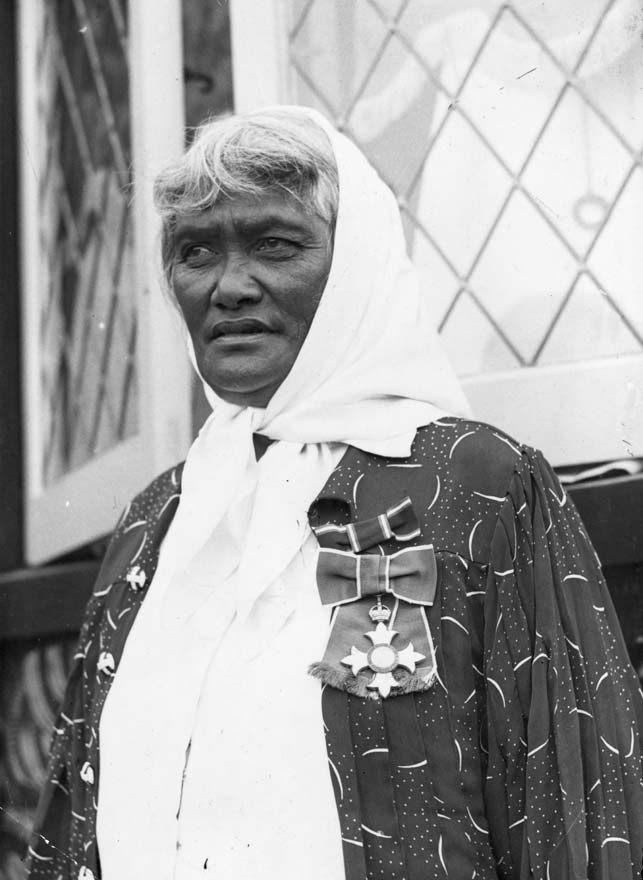
This photograph of Tainui–Waikato leader Te Kirihaehae Te Puea Herangi was taken about 1938. It shows her wearing the New Year's Honours medal she received in 1938, the Commander of the British Empire (CBE).

Te Puea was a staunch opponent of conscription for Waikato. She was guided by the words of her grandfather King Tawhiao. After he had finally made his peace with the Crown in 1881, he forbade Waikato to take up arms again:

Listen, listen, the sky above, the earth below, and all the people assembled here. The killing of men must stop; the destruction of land must stop. I shall bury my patu in the earth and it shall not rise again ... Waikato, lie down. Do not allow blood to flow from this time on.

Te Puea and others in the Waikato took this as an injunction never to fight again. Te Puea was also of the view that Waikato had 'its own King' and didn't need to 'fight for the British King'.

Alexander Turnbull Library, Wellington, New Zealand
Reference: PAColl-5584-58
Further information and copies of this image may be obtained from the Library through its Timeframes website.
Permission of the Alexander Turnbull Library, National Library of New Zealand, Te Puna Matauranga o Aotearoa must be obtained before any reuse of this image.

How to cite this page: 'Te Puea Herangi', URL: http://www.nzhistory.net.nz/media/photo/te-puea-herangi, (Ministry for Culture and Heritage), updated 30-Oct-2007

Community contributions


Anon
14 Sep 2011
Te Puea Hèrangi was born at Whatiwhatihoe in the Waikato, a grand-daughter of the second Màori king, Tàwhiao, and was educated in Màori beliefs, values, and culture. She was left motherless at fifteen and her imperious, headstrong nature led her away from her home. In 1911, however, she responded to Tàwhiao’s call to duty, and had her first taste of politics in an election campaign. Her leadership in the Kìngitanga movement thus became established, and she became determined to create a centre for the movement. She began farming at Mangatàwhiri and, opposed to the introduction of conscription in 1917, opened her farm as a refuge for those who chose not to enlist. She recognised the importance of making the best possible use of Waikato land in order to rebuild both the mana and economic strength of her people, and her skills in organisation and her own hard physical work earned widespread respect. After the devastating influenza epidemic of 1918, she gathered up 100 orphaned children and founded the community at Ngàruawahia now known as Tùrangawaewae. Hard physical work of draining and enriching the land was coupled with fund-raising for the centre, which flourished and became the vital heart for the Waikato people. Over many years Te Puea Hèrangi played a leading role in negotiating settlements for the confiscation of Waikato land, and achieved a measure of financial compensation which enabled her people to pursue economic and educational goals. She had grown up with poignant memories of the effects of war and land confiscation in the 1860s, but was committed to overcoming the alienation of her people. She worked closely with the Pàkehà world to achieve true partnership, and her energy, creativity, discipline, and vision made her a distinguished leader. Te Puea Herangi (1883–1952) was a grand-daughter of Tawhiao Te Wherowhero, the second Maori King. Her uncle Mahuta, who became King after Tawhiao, singled her out in childhood as having special abilities. He spent many hours with her, passing on his knowledge. She was to become a crucial figure in reviving the Kingitanga (King Movement) among Tainui people in the twentieth century. Te Puea emerged as a leader during the First World War. She opposed the government’s policy of conscripting Maori for war service, at a time when Tainui still felt lingering bitterness about the invasion and confiscation of their lands. The government compounded Tainui feelings of injustice by responding with a general order for Maori conscription which applied only to the King Country-Maniapoto district. After the war she helped set up a Tainui settlement at Ngaruawahia and a new marae called Turangawaewae. For the King Movement this was a new centre and a new focus, and the settlement gradually took on the flavour of a 'national marae'. Te Puea hosted several European politicians and dignitaries there, helping to restore the national status of the Kingitanga. Te Puea then focussed on improving economic conditions for Tainui. She persuaded her people to join in Apirana Ngata's ambitious Maori land development schemes. She supervised the scheme and worked hard for many years to achieve her goal of Maori economic and community revival. In 1937 Te Puea was made a CBE (Dame Commander of the British Empire). This indicated better relations between the Kingitanga and the government. But Tainui, angry that the government did not acknowledge their King’s mana (authority), did not attend the Treaty centennial celebrations at Waitangi in 1940. In 1926 the Sim Commission had investigated grievances over the land confiscations of the 1860s. Although its terms of reference were limited, it upheld many Maori grievances. The government made various offers, and in 1946 Te Puea played a part in Waikato accepting Prime Minister Peter Fraser's offer of a £5,000 annual payment in perpetuity, to be administered by a Trust Board. Although many Waikato Maori thought this sum was grossly inadequate, Te Puea felt it was the best that could be achieved in the circumstances. Until her death in 1952 she remained active in the social and economic life of the Tainui people.

What do you know?

Can you tell us more about the information on this page?
Perhaps you have a related experience you would like to share?

The content of this field is kept private and will not be shown publicly.
CAPTCHA
This question is for testing whether you are a human visitor and to prevent automated spam submissions.

Comments will be reviewed prior to posting. Not all comments posted. Tell me more...