
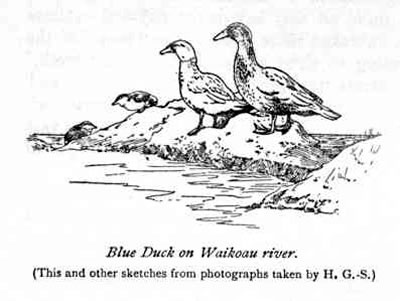
Sketch of birdlife at Tutira based on photograph by Herbert Guthrie-Smith.
A study of the 'soil and those who touch its surface'
An internationally acclaimed classic of ecological writing, William Herbert Guthrie-Smith's Tutira: the story of a New Zealand sheep station (1921) was New Zealand's first significant environmentalist publication.
In September 1882 Guthrie-Smith and Arthur Cuningham took over the lease of Tutira, a run-down, bracken-covered 8100-ha sheep station north of Napier, for £9750. For Guthrie-Smith it was the beginning of a lifelong passionate identification with this place. He later wrote: 'some spots on earth … inspire in their owners a very special affection … an occult sympathy betwixt the elementals of the soil and those who touch its surface with their feet'. In 1903 Guthrie-Smith took sole control of Tutira, by now a profitable enterprise running 32,000 sheep.
After the First World War Guthrie-Smith concentrated on his magnum opus, a massively comprehensive book that would integrate 40 years of records and observations, notes and anecdotes to give a complete account of Tutira station. His governing principle was an 'insistence on the cumulative effects of trivialities,' an attempt 'to impress upon the reader's mind details, each one of them insignificant in itself, but far from futile when in totality conjoined and harmonised'.
Tutira: the story of a New Zealand sheep station was published in 1921 (and reprinted with a new preface, map and index in 1926). All aspects of the natural history of the station are covered: geology and soils; erosion, subsidence and catchment flows; rainfall statistics and seasonal weather patterns; the formation and siltation of lakes and wetlands. Guthrie-Smith's revised edition (1953) included new chapters on the 1931 Hawke's Bay earthquake and its local effects.
Native birds and plants are constant priorities. Guthrie-Smith lists every species found before the clearances following European settlement. He traces the evidence of primeval forest cover, outlining the shapes of ancient tree-trunks preserved in bogs. Two chapters follow the slow sequential processes of regeneration.
Guthrie-Smith gives a detailed and respectful account of the Māori history of the area, and discusses Ngāi Tatara's relationships with the land and natural resources such as the eel fisheries at Lake Tūtira. The history of European occupation is given equally thorough attention. Guthrie-Smith includes excerpts from his predecessors' journals; he provides exhaustive practical analysis of different pasture grasses and breeds of sheep, the intricacies of shepherding and droving, foot-rot and stock trails, mortgages and fluctuating wool prices.
The impacts of exotic plants and animal pests are given close attention. The insidious spread of hundreds of alien plants is recorded: these include both deliberate imports such as the potato, peach and mint planted at Māori dwelling-sites, and undesirables like blackberry, thistles and rapidly multiplying weeds. He details the encroachments of animal pests (rats and mice, deer, rabbits and hares, weasels), insects, and numerous European birds, including the ubiquitous sparrow.
Tutira was acclaimed within New Zealand and internationally, winning recognition as a provocative and unique work. Guthrie-Smith's style is fluent, accessible, even chatty, a relaxed mix of science, anecdote, lyricism, humour and adventure; authority builds through the sheer weight of empirical observation.
Herbert Guthrie-Smith had a strong conservation ethic and was a founding member of the Native Bird Protection Society. He died on 4 July 1940 at Tutira, after completing revisions and additions for a new edition. The 810 ha that remained of the station were left in trust to the New Zealand public as an educational and recreation reserve.
Further information
- This page is adapted from a biography of Herbert Guthrie-Smith by Ronda Cooper (DNZB)
- Digitised version of the second edition of Tutira (NZETC)


Community contributions