
He Whakaputanga o te Rangatiratanga o Nu Tirene: the Declaration of Independence of the United Tribes of New Zealand
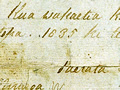
In 1831, 13 Ngāpuhi chiefs wrote to King William IV of the United Kingdom to seek an alliance and protection from other powers. On 28 October 1835 James Busby took this a step further at a hui (meeting) he had called at Waitangi. By the end of the day 34 rangatira had signed He Whakaputanga o te Rangatiratanga o Nu Tireni (known in English as the Declaration of Independence of the United Tribes of New Zealand).
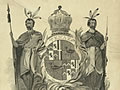
Busby had acted partly in response to Frenchman Charles Philippe de Thierry, who had announced plans to proclaim an independent state in Hokianga. The self-declared nobleman’s claims were in the end easily dismissed, but the fact remained that if Britain did not intervene in New Zealand, another country might do so.
What did He Whakaputanga say?
There are two versions of the Declaration: the English text created by Busby, and the te reo Māori document that was signed. He Whakaputanga (which can be translated as 'an emergence' or 'declaration') consisted of four articles. It asserted that sovereign power and authority in the land (‘Ko te Kingitanga ko te mana i te w[h]enua’) resided with Te Whakaminenga, the Confederation of United Tribes, and that no foreigners could make laws. Te Whakaminenga was to meet at Waitangi each autumn to frame laws, and in return for their protection of British subjects in their territory, they sought King William's protection against threats to their mana. They also thanked the King for acknowledging their flag.
Thirty-four northern chiefs signed He Whakaputanga on 28 October 1835. Busby sent it to the King, and it was formally acknowledged by the Crown in May 1836. By 22 July 1839 another 18 chiefs had signed, including Te Hāpuku of Hawke’s Bay, and Te Wherowhero, the Waikato Tainui ariki who was to become the first Māori king in 1858.
Busby saw the Declaration as a step towards making New Zealand a British possession. He believed it would ‘be the most effectual mode of making the Country a dependency of the British Empire in everything but the name.' Busby was also locked in a bitter dispute with Thomas McDonnell, the Hokianga-based Additional British Resident. Against the wishes of Busby, McDonnell had encouraged rangatira to ban liquor sales in the Hokianga. For Busby, the Declaration was an opportunity to reassert himself at the expense of McDonnell.
Māori intentions were somewhat different. The rangatira who signed He Whakaputanga were continuing a tradition of safeguarding their people in the face of rapid change. Northern Māori had been meeting in the Bay of Islands, Hokianga, Whangaroa, and Whangārei before 1835 to manage their relationships with Europeans. In contrast to Busby, the signatories saw He Whakaputanga as a way to address the challenges posed by European contact, to strengthen an alliance with Great Britain, and to assert their authority to the wider world. For Ngāpuhi, He Whakaputanga emerged out of the meetings of Te Whakaminenga, rather than Te Whakaminenga emerging from He Whakaputanga.
Reactions to the Declaration
Busby sent the English text to both the New South Wales government and the Colonial Office in London. Governor Bourke of New South Wales referred to the Declaration as ‘a paper pellet fired off at Baron de Thierry.' Although a Colonial Office official called it ‘silly and unauthorised’, Lord Glenelg, the secretary of state for the colonies, was more enthusiastic, advising the King that it showed ‘a due regard to the just rights of others and to the interests of His Majesty’s subjects.'
The Declaration in practice
No Western-style, New Zealand-wide government came into existence as a result of the Declaration. As far as Busby was concerned, effective sovereignty lay not with the United Tribes but with the chiefs of individual iwi and hapū. However Ngāpuhi histories of He Whakaputanga note that after 1835 Te Whakaminenga continued to meet and discuss how to deal with Europeans, even during times of inter-tribal conflict.
Interpretations of the Declaration
The significance of He Whakaputanga has been widely debated by historians in recent years. Most Pākehā writers viewed it as an attempt by Busby to establish – with little or no Māori input – a ‘settled form of government’ and dismissed its significance. Keith Sinclair described the Declaration’s recognition of indigenous sovereignty as a ‘polite fiction’, while Michael King maintained that the Declaration ‘had no reality, since there was … no national indigenous power structure within New Zealand.'
Submissions to the Waitangi Tribunal have challenged this perspective. Assertions of Māori agency in the making of He Whakaputanga and explanations of their reasons for signing have shed new light on the document. A greater awareness of Māori forms of governance has also changed how Te Whakaminenga has been viewed. Decisions were made in a co-operative way and with respect for the autonomy of hapū. According to Nuki Aldridge, ‘Te Whakaminenga could make decisions or create laws with hapū consent, but not override hapū authority.’
He Whakaputanga became a foundation for the assertion of indigenous rights and was another step towards a formal constitutional relationship with Britain. Tom Brooking argued that the Colonial Office accepted the Confederation of United Tribes as bestowing ‘indisputable’ Māori ‘title to the soil and the sovereignty of New Zealand.' For many, though, the Declaration was primarily a matter for Ngāpuhi. Paul Moon saw it as a ‘regional goodwill agreement rather than a national document of truly constitutional significance.'
Some historians suggest that the Declaration was only taken seriously by the British in 1840, when it proved to be an impediment to the annexation of New Zealand. Before sovereignty could be transferred to the British crown via the Treaty of Waitangi, the Declaration had to be revoked. This is why the chiefs who had signed the Declaration, or their successors, were the first men to be called up to sign the Treaty.
Others argue that this view downplays the constitutional importance of He Whakaputanga and its influence in the Māori world. Vincent O’Malley notes that later Māori unity movements, such as the Kīngitanga and Te Kotahitanga, looked to He Whakaputanga as the basis for Māori claims to self-determination. It also represented an important development in a Māori sense of nationhood and identity while reaffirming tikanga Māori and Māori concepts of power and decision-making.


