
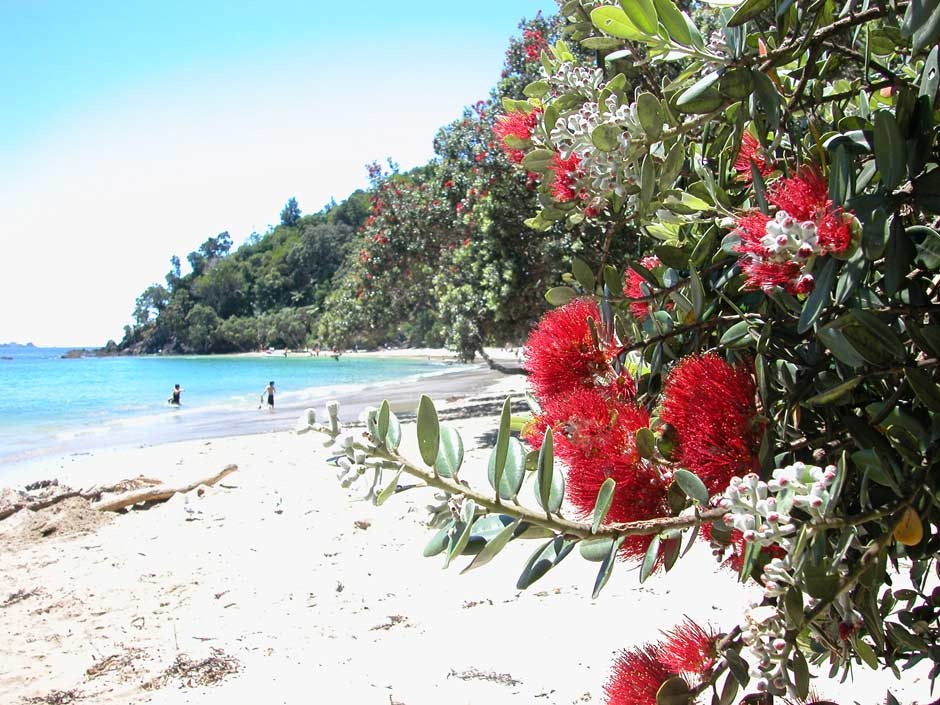
The pōhutukawa tree (Metrosideros excelsa) with its crimson flower has become an established part of the New Zealand Christmas tradition. This iconic Kiwi Christmas tree, which often features on greeting cards and in poems and songs, has become an important symbol for New Zealanders at home and abroad.
In 1833 the missionary Henry Williams described holding a service under a ‘wide spreading pohutukawa’. The first known published reference to the pohutukawa as a Christmas tree came in 1857, when ‘flowers of the scarlet Pohutukawa, or “Christmas tree”’ formed part of table decorations at a feast put on by Ngāpuhi leader Eruera Patuone. Several years later Austrian geologist Ferdinand Hochstetter noted that settlers referred to it as such. The pohutukawa, he observed, ‘about Christmas … are full of charming … blossoms’; ‘the settler decorates his church and dwellings with its lovely branches’. Other 19th-century references described the pōhutukawa as the ‘Settlers Christmas tree’ and ‘Antipodean holly’.
In 1941 army chaplain Ted Forsman composed a carol in which he referred to ‘your red tufts, our snow’. Forsman was serving in the Libyan Desert at the time, hardly the surroundings normally associated with pōhutukawa. Many of his fellow New Zealanders, though, would have instantly identified with the image.
Today schoolchildren sing about how ‘the native Christmas tree of Aotearoa’ fills their hearts ‘with aroha’.
Pōhutukawa and its cousin rata also hold a prominent place in Māori tradition. Legends tell of Tāwhaki, a young warrior who attempted to find heaven to seek help in avenging the death of his father. He fell to earth and the crimson flowers are said to represent his blood.
A gnarled, twisted pōhutukawa on the windswept clifftop at Cape Rēinga, near the northernmost tip of New Zealand, is of great significance to many New Zealanders. For Māori this small tree is known as ‘the place of leaping’. It is from here that the spirits of the dead begin their return journey to their traditional homeland of Hawaiki. The spirits leap off the headland and climb down the roots of the 800-year-old tree, descending into the underworld.


Community contributions