
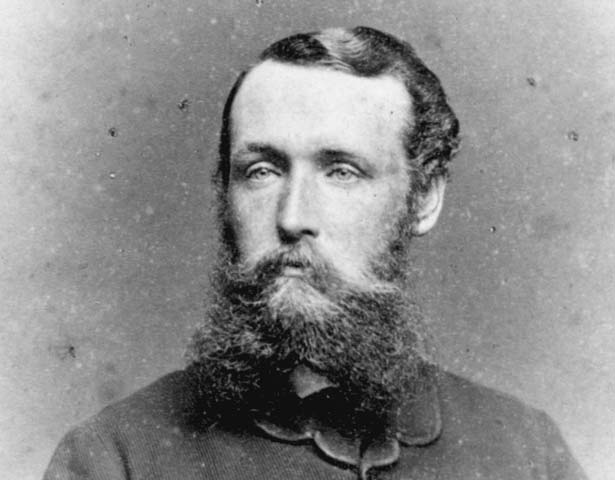
Gilbert Mair (1843–1923) was born at Whangārei. As a young man working in his father's Northland kauri gum business he came into close contact with Māori, and learned the Māori language. He later became a surveyor, and a clerk and interpreter at the Tauranga Resident Magistrate's Court.
When fighting broke out at Tauranga in 1867 Mair volunteered. He served with distinction and achieved the rank of lieutenant. In 1869 he took a leading role in campaigns against Te Kooti, and was promoted to captain. Later he commanded an irregular contingent of loyalist Māori which became known as the "Arawa flying column". Mair affectionately referred to the flying column as his "forty thieves". During his military career Mair displayed initiative, skill and reckless courage. He was particularly skilled in guerrilla tactics.
After the wars Mair became a Crown land purchase agent in the central North Island. He acquired vast tracts of land, including the Kāingaroa Plains. Part of his success as a purchase agent was due to the close relationship he had forged with Te Arawa during the wars. He later became critical of the government's methods of acquiring Māori land.
Mair subsequently served as a parliamentary interpreter and Government Agent at Tauranga. He was at different times president of the Ikaroa Māori Land Board, a Resident Magistrate and Superintendent under the Māori Councils Act 1900. As Superintendent he was required to enforce a range of regulations devised by the Te Arawa Māori Council.
Until his death in 1923 Mair was a Rotorua landmark - guiding and interpreting, and hosting many notable visitors to the Hot Lakes District. He has been described as a "not always ethical collector of Maori artifacts", but despite this he maintained a close relationship with Te Arawa. Mair is one of the few Europeans to be buried in the Te Arawa cemetery at Ōhinemutu.
Adapted from the DNZB biography by Paula Savage
How to cite this page
'Gilbert Mair', URL: https://nzhistory.govt.nz/people/gilbert-mair, (Ministry for Culture and Heritage), updated 13-Jan-2022


Community contributions