
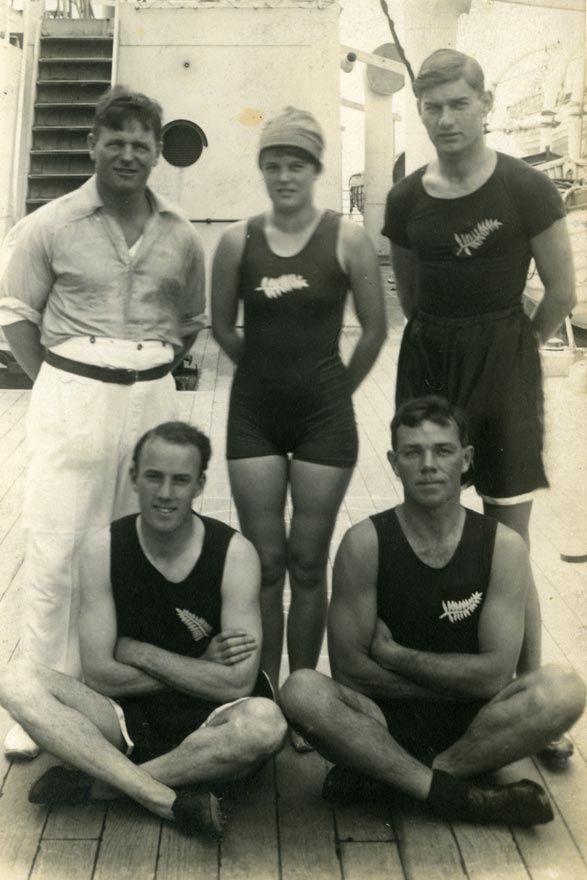
The New Zealand Olympic team en route to Antwerp in 1920. Rower Darcy Hadfield sits at bottom right. Violet Walrond, our first female Olympian, stands between her father Tui (in the white pants) and George Davidson, with Harry Wilson at bottom left.
The 1920 team
Several New Zealand athletes competed – and won medals – as part of ‘Australasian’ teams at the 1908 and 1912 Olympics. This country’s first official team competed at Antwerp in 1920. The first Games to be held after the First World War, the event was awarded to Belgium to honour that country’s enormous suffering during the war. The Games began with a requiem mass in Antwerp Cathedral, and for the first time at the Olympics doves were released to symbolise peace. With more than 4600 Kiwi soldiers lying in Belgian war graves, the venue was laden with meaning for many New Zealanders.
The New Zealand team consisted of just four athletes: sculler Darcy Hadfield, sprinter George Davidson, hurdler Harry Wilson and teenaged swimmer Violet Walrond, our first female Olympian. Violet’s father Tui, who was also her swimming coach, acted as both her chaperone and the team’s unofficial coach.
Like many Olympic competitors in 1920, Hadfield had been in Belgium before, in very different circumstances. While serving with the 1st Battalion of the Auckland Infantry Regiment in 1917, he was wounded during the disastrous battle of Passchendaele. After recuperating in England, in 1919 he won the single sculls at both the Royal Henley Peace Regatta and the Inter-Allied Games in Paris.
Hadfield’s preparation for the 1920 Olympics was far from ideal. The New Zealanders’ sea journey was delayed in both Australia and South Africa, and they arrived after nine weeks of travel. With little opportunity for training during the voyage, he was disadvantaged compared with his European and American opponents. He finished third in the single sculls final, behind Jack Kelly of the United States (father of actor Grace Kelly) and Jack Beresford of Great Britain, becoming the first New Zealander to win an Olympic rowing medal.
His teammates also performed well, each making a final. Harry Wilson narrowly missed out on a medal, finishing fourth in the 110-m hurdles, while George Davidson and Violet Walrond each claimed a fifth placing, in the 200-m sprint and 100-m freestyle respectively.
In 1922 Hadfield turned professional, challenging – and beating – the reigning world sculling champion, fellow New Zealander Dick Arnst, in a race on the Whanganui River. Hadfield lost the title to an Australian sculler three months later and retired from serious competition the following year.
The Olympic rowing tradition Hadfield started in 1920 has since flourished. By the end of the 2012 London Games New Zealand rowers had won a total of 21 medals (nine gold, two silver and ten bronze).


Community contributions