
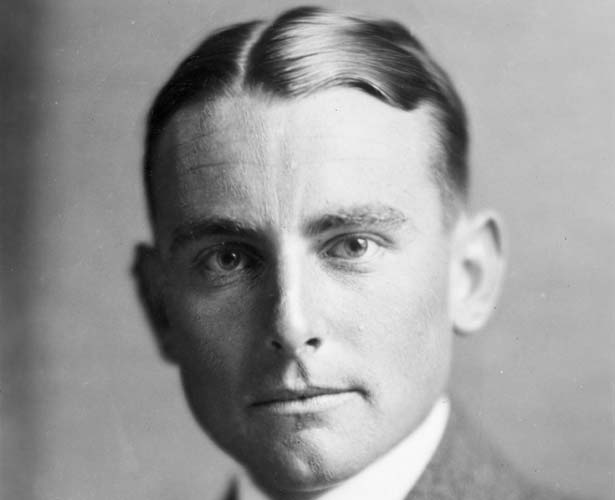
The obituaries for Sir Geoffrey Cox rightly highlighted his role as a 'TV trailblazer' and the 'Founder of News at 10' for Britain's Independent Television News (ITN). But most also drew attention to his role as an eyewitness to momentous events in Europe during the 1930s and '40s.
Cox wrote extensively of his experiences at the time - in Defence of Madrid (1937), The Red Army moves (1941) and The road to Trieste (1947) - and in the years that followed – in A tale of two battles (1987), Countdown to war (1988) and Eyewitness (1999). Just how did a boy born in Palmerston North come to witness at first hand the impact of Stalinism, the rise of Hitler and the Spanish Civil War?
Cox grew up in Invercargill and was educated at Southland Boys' High School. After completing an MA in history at Otago University he took up a Rhodes scholarship. During his first year at Oriel College, Oxford, in 1932 Cox made his first trip to the Soviet Union and Germany. He returned to Germany in 1934, this time working in a Nazi labour camp and attending the Nazi Party's annual Nuremberg Rally. In his memoir of Europe in the 1930s, Eyewitness, he writes that it was his labour camp experiences that got him into journalism in Britain, where he forged a long and illustrious career.
To write this memoir, published in 1999, Cox drew on his letters to his parents, 'intermittent diary notes', his accounts of specific incidents and events, and articles he had written as a journalist. It is a dynamic recollection of events in Europe as he witnessed them, but with the benefit of hindsight. For example. Cox reflects on the likely fate of the men with whom he had shared songs at the labour camp:
I thought I should counter [the seamen's ballads and hiking songs] with some Antipodean culture, so I taught them a Maori haka. They took readily to its drilled, rhythmic gestures and its full-throated chants … I have since wondered whether fate decreed that any of those who chanted or watched the haka that night were later, as soldiers in Crete or the Western Desert, to hear its like roared out in reality as the Maori Battalion of the 2 NZ Division came towards them.
In contrast, Cox's first book, Defence of Madrid, was written immediately after his return to England from covering the 'Battle for Madrid' in Spain in late 1936. Still relatively new to journalism, Cox was given the opportunity after the London News Chronicle's correspondent in Madrid, Denis Weaver, was captured by Franco's forces. Cox ably covered the conflict from late October until mid-December, but found on his return to England that more senior journalists were now clamouring to be sent to Spain. Realising that he would not be going back any time soon, Cox wrote an account of his sojourn in Madrid. His eyewitness report, first published in early 1937, has become one of the classic accounts of the Spanish Civil War. It was republished in a new edition by Otago University Press on the 70th anniversary of the battle.
Shortly after the initial publication of Defence of Madrid, Cox became a foreign correspondent for the Daily Express, for which he worked until 1940, when he decided to join the 2nd New Zealand Expeditionary Force. Cox became General Bernard Freyberg's chief intelligence officer but continued to write. In 1941 he compiled four issues of a newspaper for New Zealand soldiers in Crete and published The Red Army moves, his account of the Soviet Union's invasion of Finland.
Though Cox returned to print journalism after the war he soon had an eye on a new medium - television. In 1956 he was appointed editor and chief executive of the news service of Independent Television News (ITN). Cox wrote about this stage of his career in See it happen: the making of ITN (1983) and Pioneering television news (1995). He was indeed a pioneer in the development of television news in Britain, responsible in particular for the introduction of half-hour news bulletins.
In 1966 Cox was knighted for services to journalism. In 2000 was appointed a Companion of the New Zealand Order of Merit for services to this country and its interests in the United Kingdom. He died in April 2008, just days before his 98th birthday.
Further information:
- Geoffrey Cox, Eyewitness: a memoir of Europe in the 1930s, University of Otago Press, Dunedin, 1999
- Geoffrey Cox, Defence of Madrid: an eyewitness account from the Spanish Civil War, 2nd edn, Otago University Press, Dunedin, 2006
- Obituary for Sir Geoffrey Sanford Cox (Stuff website)
- New Zealand combatants in Spain
How to cite this page
'Geoffrey Cox', URL: https://nzhistory.govt.nz/people/geoffrey-cox, (Ministry for Culture and Heritage), updated 24-Nov-2020


Community contributions