
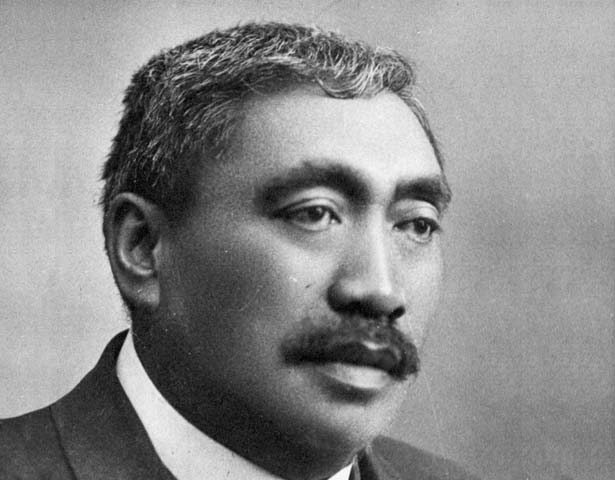
Hēnare Kaihau, of Ngāti Te Ata, was born some time between 1854 and 1860 on the southern Manukau Harbour. In his youth he acquired a vast knowledge of tribal tradition and whakapapa. By his mid-twenties he had become deeply interested in Māori politics. Later he strongly supported the King movement, and was a principal adviser to Mahuta, the third Māori King.
He was elected to Parliament representing the Western Māori electorate in 1896. One of his first actions was to introduce the Māori Council Constitution Bill. Under the bill, a Māori council of 56 members would have full authority over land and fishing grounds. It would replace the Native Land Court and make decisions on land titles. The bill was rejected.
Throughout his remaining 15 years in Parliament Kaihau spoke on many issues – calling for Māori Treaty rights to fish and native game, opposing legislation that reduced Māori control and ownership of their lands, and constantly seeking compensation for confiscated Waikato land.
At the start of the 20th century he became deeply disillusioned by what he saw as Parliament's lack of commitment to Māori issues. He focused on re-establishing the Māori Kotahitanga Parliament under the Māori King. The Kotahitanga movement, which had declined after 1900, had sought implementation of the Treaty of Waitangi, repeal of the native land laws and a measure of Māori independence.
Large hui (meetings) were held in 1907, but Kaihau was unable to break down either the division among Kīngitanga members, or their suspicion of tribes outside it.
In 1908 Waikato leaders sold or leased land to raise funds for the development of a township at Ngāruawāhia. Kaihau's involvement in these transactions led to accusations of financial impropriety. Later he was also accused of accepting payment from electors for his work on petitions, and of taking fees for facilitating land purchases. Parliament's Speaker investigated, and supported the charges. But there was no penalty because Standing Orders in Parliament were not translated into Māori, and according to the Speaker, Kaihau might not have known that he was acting improperly.
After this the King Movement withdrew its support. Kaihau lost his seat in Parliament and was replaced by Māui Pomare. He died in 1920.
How to cite this page
'Hēnare Kaihau', URL: https://nzhistory.govt.nz/people/henare-kaihau, (Ministry for Culture and Heritage), updated 21-Mar-2023


Community contributions