
At the outbreak of war in 1914, Horace Moore-Jones was living in Britain. He was 42 years old, but gave his age as 32 so he could enlist with the New Zealand Expeditionary Force (NZEF).
Moore-Jones was sent to Gallipoli with the Engineers, but was soon deployed to draw topographical maps of the area for military purposes. Towards the end of 1915 his drawing hand was injured. While recovering in England, he somehow managed to produce nearly 80 watercolours of Gallipoli.
These watercolours were first exhibited at New Zealand House, London, in April 1916, and were received well by the military and public. The head of the NZEF, Alexander Godley, said: ‘Nothing that I have seen or read on the subject of Anzac brings more vividly to my memory the pleasantest features of our sojourn there.’ Moore-Jones was more critical of his experience, saying that Gallipoli was like eight months of hell:
You can imagine what it must be like to live, day after day, facing plateaus that are covered with one’s dead comrades, whose faces had grown black by the time we could reach them, and the over-powering sickening stench. And what it meant to sit, eating one’s bread and jam surrounded by millions of flies who had been bred on dead bodies.
Declared medically unfit, Moore-Jones returned to New Zealand in 1917 and toured the country exhibiting his watercolours. These became departure points for his ‘descriptive lectures’ about the campaign. The New Zealand government refused to buy the watercolours, so in 1920 he sold them to the Australian government for £1500 (about $130,000 today). The series, which can be viewed on the Australian War Memorial’s website, has become ‘a vital part of the art collection of the Australian War memorial [as they] provide a quiet, but honest, contemporary record of the terrain of Gallipoli. They are poignant human documents.’
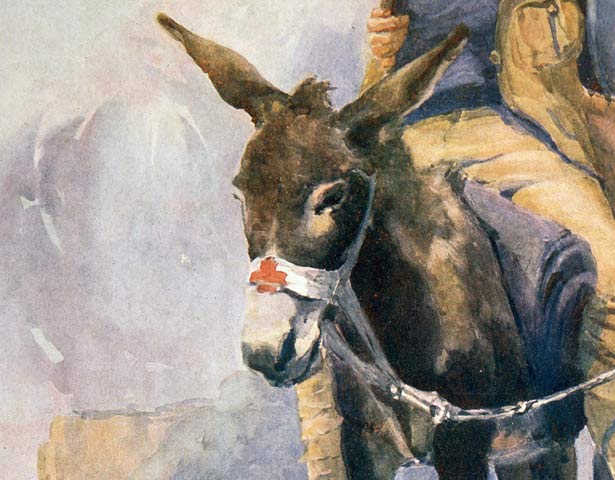
Moore-Jones’ most widely recognised work was not painted at the battlefront, but from a photograph. His depiction of Private Simpson and his donkey was done when Moore-Jones was showing his watercolours in Dunedin in 1918. He altered the composition of the photo to make the image more dramatic.
Moore-Jones died of burns suffered while rescuing people from a Hamilton hotel fire in 1922.
Adapted by Caroline Lord from the DNZB biography by Anne Gray
Further Information:
How to cite this page
'Horace Moore-Jones', URL: https://nzhistory.govt.nz/people/horace-moore-jones, (Ministry for Culture and Heritage), updated 21-Mar-2023


Community contributions