
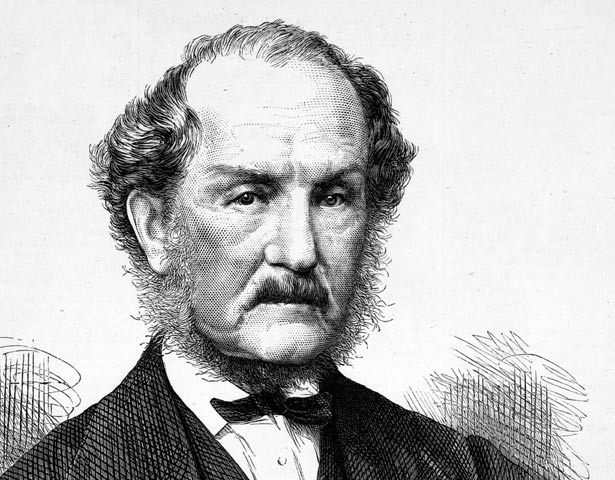
Born in Newcastle upon Tyne in 1813, Isaac Featherston spent his early life studying medicine in Edinburgh and working as a physician in Italy and across Europe.
Suffering from persistent ill health and a weak constitution, he eventually travelled further afield in search of a more suitable climate. Featherston made his passage to New Zealand as surgeon superintendent aboard the Olympus, a ship owned by the New Zealand Company, through which he had purchased land in the new settlement of Wellington.
On arrival, he expressed shock at the primitive state of the ‘city’, describing it as little more than ‘mud hovels’ and ‘wooden huts’. His anger was compounded on discovering that the ‘fine fertile land’ he had been sold was actually ‘useless swamp, worth nothing’.
Despite these setbacks, Featherston threw himself into community-building initiatives and other civic activities, developing a reputation as ‘leader of the settlers’. One of his first achievements was to secure compensation for Wellington landowners, pitting him squarely against the interests of the New Zealand Company and its representatives, the Wakefields.
In 1845 Featherston became the first editor of the Wellington Independent, using his position to articulate the growing demand from Wellington settlers for some form of representative government. He was known as a staunch provincialist and advocated strongly for the maximum possible devolution of functions and powers to the provincial councils. It is no surprise that successive Governors found him highly difficult and insubordinate.
His antagonism toward the Wakefields came to a head in 1847 with an armed duel with William Wakefield in Te Aro. Fortunately, Wakefield was unwilling to ‘shoot a man who had seven daughters’, and Featherston’s life was spared.
Little is known of Featherston’s personal life. He married Bethia Campbell Scott, at Edinburgh on 10 December 1839, and they had eight daughters and four sons together, all but one of them born in New Zealand. Bethia noted Featherston’s ‘rather antiquated’ views about the rights of women, although other observations point to a man who could be genial and humorous in private.
When elections were finally held in 1853, Featherston was elected unopposed as provincial Superintendent. He went on to serve as a member of the House of Representatives, colonial secretary and minister without portfolio. Later, he was appointed New Zealand’s first Agent-General, playing an instrumental role in shaping the country’s early immigration policy.
Featherston passed away in 1876. He is remembered as a complex but powerful figure, who led the city, district and province of Wellington with all the courage of his convictions.
How to cite this page
'Isaac Featherston', URL: https://nzhistory.govt.nz/people/isaac-featherston, (Ministry for Culture and Heritage), updated 19-Nov-2020


Community contributions