
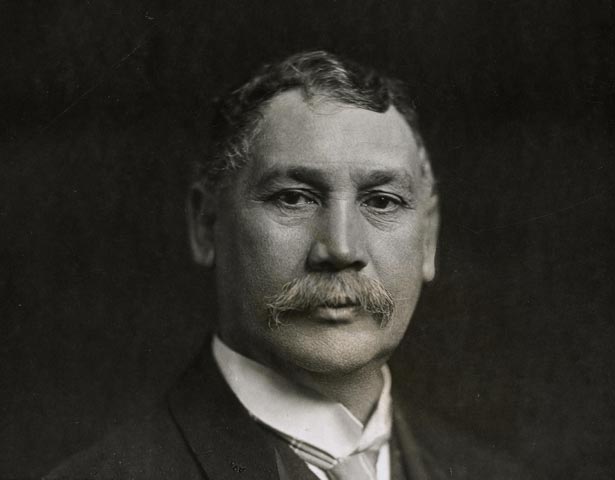
James Carroll was born at Wairoa, in northern Hawke's Bay, in 1857. His father was European. His mother was of Ngāti Kahungunu. In 1870, although only 13, he joined the campaign against Te Kooti and was mentioned in despatches. He later became a cadet in the Native Department, and took part in selling land on the East Coast.
Despite the prospect of a promising career in the government, Carroll returned to the East Coast in 1875 and took up farm work. He later returned to Wellington as an interpreter to the House of Representatives. This led to his interest in politics, and in 1887 he became member for Eastern Maori.
Carroll’s main aim in Parliament was to empower Māori and secure a role for them in the economic life of the country. But the Native Lands Acts did not reflect this ideal or, according to Carroll, enhance Māori ability to control and use their land.
In 1891 the Liberal government appointed him to a commission of inquiry into Māori land laws. This became known as the Rees–Carroll Commission. It bitterly criticised the Native Land Court for granting Māori land title to individuals rather than iwi (tribe) or hapū (sub-tribe). It recommended that hapū hold the title to land, which would be administered by "block committees", representing the landowners.
When the Crown acquired land, preferably by leasing, land boards should manage it. Māori and Europeans would be represented equally on the boards. Carroll also strongly criticised the lack of training and other support for Māori farmers.
The government did not act on these recommendations. Carroll remained a leading critic, often citing the Treaty of Waitangi in support of Māori rights.
In 1892 he was appointed to Cabinet as representative of the Māori race. In accepting the position he had to publicly support the Liberals' drive to acquire Māori land. Members of the Kotahitanga movement criticised him for this. They sought implementation of the Treaty of Waitangi, cancellation of the native land laws, and some autonomy through a separate Māori Parliament.
Carroll's opponent in the Eastern Maori seat was Wī Pere, a strong supporter of Kotahitanga. This was one reason why Carroll decided to stand for the general (European) electorate of Waiapu in the 1893 election. He won by 497 votes, and held the seat until 1908, when he won the Gisborne general seat.
Carroll continued to oppose the more extreme Kotahitanga separatists, as his goal was for Māori to develop within the European mainstream. He believed it was better for Māori to suffer "momentary pain" in order to enjoy a "lasting benefit".
Carroll continued to call for less radical and non-separatist Māori institutions which he believed would assist in advancing the race, including the management of land by elected committees. In 1899 he was made Native Minister by Seddon, the Liberal Premier. He was the first Māori to hold this office, which he retained until 1912.
In the late 1890s he persuaded the Kotahitanga movement to accept a compromise with the government. This took the form of the Maori Councils Act and the Maori Lands Administration Act. The former provided for Maori Committees to take control of a range of local matters, including sanitation and health. The latter set up land councils with a majority of Māori members which could sell or lease land which owners voluntarily passed to them. Block committees were also set up to assist the Native Land Court in its deliberations.
However, there was opposition from settlers, and distrust from Māori. The councils did not receive enough funds, and little land was placed under the control of the land boards. After 1905 pressure from settlers led to the watering down or removal of safeguards, and the scale and speed of land alienation increased significantly.
The 1909 Native Land Act did nothing to limit increasing land alienation. It can be argued that Carroll was ultimately unable to balance competing Māori and European interests. As the historian Alan Ward notes, the forces demanding purchase of Māori land, including those within Carroll's own Liberal Party, were simply too great for him to resist.
Carroll served twice as acting Prime Minister - in 1909 and 1911 - and was knighted in 1911. In 1921 he lost his seat and was appointed to the Legislative Council. He died in 1926.
Adapted from DNZB entry written by Alan Ward.
How to cite this page
'James Carroll', URL: https://nzhistory.govt.nz/people/james-carroll, (Ministry for Culture and Heritage), updated 8-Nov-2017


Community contributions