
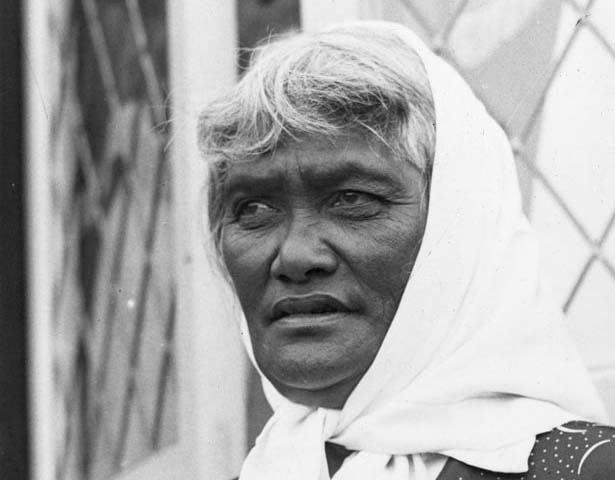
Te Puea Hērangi (1883–1952) was a granddaughter of Tāwhiao Te Wherowhero, the second Māori King. Her uncle Mahuta, who became King after Tāwhiao, singled her out in childhood as having special abilities. He spent many hours with her, passing on his knowledge. She was to become a crucial figure in reviving the Kīngitanga (King Movement) among Tainui people in the 20th century.
Te Puea emerged as a leader during the First World War. She opposed the government’s policy of conscripting Māori for war service, at a time when Tainui still felt lingering bitterness about the invasion and confiscation of their lands. The government compounded Tainui feelings of injustice by responding with a general order for Māori conscription which applied only to the King Country-Maniapoto district.
After the war Te Puea helped set up a Tainui settlement at Ngāruawāhia, and a new marae called Tūrangawaewae. For the King Movement this was a new centre and a new focus, and the settlement gradually took on the flavour of a ‘national marae’. Te Puea hosted several European politicians and dignitaries there, helping to restore the national status of the Kīngitanga.
Te Puea then focused on improving economic conditions for Tainui. She persuaded her people to join in Apirana Ngata’s ambitious Māori land development schemes. She supervised the scheme and worked hard for many years to achieve her goal of Māori economic and community revival.
In 1937 Te Puea was made a CBE (Dame Commander of the British Empire). This indicated better relations between the Kīngitanga and the government. But Tainui, angry that the government did not acknowledge their King’s mana (prestige), did not attend the Treaty centennial celebrations at Waitangi in 1940.
In 1926 the Sim Commission had investigated grievances over the land confiscations of the 1860s. Although its terms of reference were limited, it upheld many Māori grievances. The government made various offers, and in 1946 Te Puea played a part in Waikato accepting Prime Minister Peter Fraser’s offer of a £5000 annual payment in perpetuity, to be administered by a Trust Board. Although many Waikato Māori thought this sum was grossly inadequate, Te Puea felt it was the best that could be achieved in the circumstances.
Until her death in 1952 she remained active in the social and economic life of the Tainui people.
Adapted from the DNZB biography by Ann Parsonson
Te Kirihaehae Te Puea Hērangi (Princess Te Puea)
Ka noho a Te Puea Hērangi (1883-1952) hei mokopuna nā Tāwhiao Te Wherowhero, te Kīngi Māori tuarua. Ka mate a Tāwhiao ka matika ko tana tama a Mahuta hei Kīngi Māori tuatoru. Ko ia te mea ka kite i ngā pūmanawa ake o Te Puea i a ia e tamariki tonu ana. Ka nui te wā ka noho a Mahuta ki te kōrero ki a ia, ki te tuku i ana mātauranga ki a Te Puea. Ā tōna wā ko ia tētahi ka whai wāhi nui ki te whakaora i te Kīngitanga i waenganui i ōna iwi o Waikato i te rautau rua tekau.
Ka hau te rongo mō Te Puea i te wā o te Pakanga Tuatahi o te Ao. Nāna i ārahi ngā mautohe e ātete ana ki te kaupapa māperetanga a te kāwanatanga. I taua wā, kei te pōuri tonu ngā iwi o Waikato mō te whakaekenga me te raupatunga o ō rātou whenua. I te whakataunga a te kāwanatanga i te māperetanga ki runga i ngā Māori anake o Te Rohe Pōtae me Waikato, kātahi ka pōuri rawa atu te iwi.
I te mutunga o te pakanga, ka āwhina a Te Puea i ngā mahi kia tū he kāinga mō ngā iwi o Tainui ki Ngāruawāhia. Ka whakatūria he marae hou ki reira, ko Tūrangawaewae. He pokapū hou, he arotahinga hou tēnei mō te Kīngitanga. Ka nui atu te awe o Tūrangawaewae, ki ētahi, ko tōna ritenga, hei "marae mō te motu". Ka pōwhiritia e ia ngā kaitōrangapū me ngā rangatira Pākehā ki reira. Ka kake haere te mana o te Kīngitanga.
Kātahi ka tahuri a Te Puea ki ngā kaupapa ōhanga hei whakapai ake i te noho a ngā iwi o Tainui. Nāna tōna iwi i kuhu ki ngā kaupapa ahuwhenua a Āpirana Ngata. Ko ia te kaiwhakahaere o ngā kaupapa ahuwhenua ki roto i tōna iwi, ka mutu, ka pau ngā tau e tutuki ai tōna whāinga, arā, kia ora anō te ōhanga me ngā hapori o te iwi Māori.
Nō te tau 1937 ka whakawhiwhia a Te Puea ki te tohu whakahōnore CBE, he tohu pea kua pai te titiro a te Kīngitanga me te kāwanatanga, tētahi ki tētahi. He aha hoki. I te pōuri tonu a Tainui i te kore whakaae o te kāwanatanga ki te mana o te Kīngi. I runga i tērā, kāore ngā iwi o Tainui i haere ki te hui whakanui i te rau tau o te Tiriti o Waitangi i Waitangi i te tau 1940.
I te tau 1926 ka rangahau te Kōmihana a Sims i ngā nawe i pupū ake i te raupatunga o ngā whenua Māori i te tekau tau atu i 1860. Ahakoa te whāiti o tana titiro, ka whakaae te Kōmihana ki te maha o ngā whakapae. Ka tāpaea e te kāwanatanga ētahi whakaritenga ki mua i te iwi. I te tau 1946 ko Te Puea tētahi ka tautoko i te tāpaetanga nā Te Pereiha (Peter Fraser) i whakatakoto ki mua i a Waikato. Mā tēnei whakaritenga ka whiwhi te iwi i te rima mano pāuna ia tau mō ake tonu atu, ka whakatūria he Poari Kaitiaki hei whakahaere. Ko te whakapae a ētahi o te iwi, he itiiti rawa te rima mano pāuna; hei tā Te Puea, koia nei te rahinga rawa atu ka tareka i raro i ngā āhuatanga o te wā.
Tae rawa ki tōna matenga i te tau 1952, ko Te Puea tērā i roto i ngā nekeneke katoa o ngā iwi o Tainui.
How to cite this page
'Te Puea Hērangi', URL: https://nzhistory.govt.nz/people/te-kirihaehae-te-puea-herangi, (Ministry for Culture and Heritage), updated 13-Jul-2020


Community contributions