
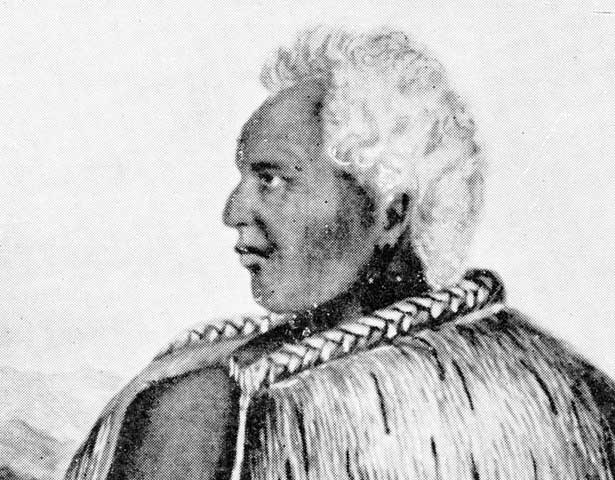
Kawiti, probably born in the 1770s in northern New Zealand, was a notable Ngāpuhi chief and warrior and a skilled military tactician.
In 1840, when William Hobson arrived in New Zealand, Kawiti vigorously resisted British rule. He did not agree to the Treaty on 6 February, when others signed at Waitangi, but his people pressed him to sign, which he did, albeit reluctantly, at a special meeting with Hobson in May 1840. On 11 March 1845, though, he joined forces with Hōne Heke at Kororāreka when his men created a diversion while the flagstaff on Maiki Hill was cut down for the fourth and last time.
The Northern War of 1845-46 involved the forces of Kawiti and Heke against British troops and Māori allies. The British launched three major expeditions into the hinterland of the Bay of Islands. The first, at Puketutu, was a Māori victory, despite British claims to the contrary. At Ohaeawai, he constructed a carefully designed pa that withstood a British attack on 1 July 1845. Outnumbered six to one, the Maori forces nevertheless inflicted a serious defeat on the British. Fighting ceased for five months while Governor Robert FitzRoy tried to arrange a peace, but Kawiti rejected the terms offered.
When George Grey arrived in November 1845 to replace FitzRoy, he gave Kawiti and Heke five days to respond to the peace offer and organised an expedition against Kawiti's new pa. Kawiti drew British troops to battle on a fairly inaccessible site at Ruapekapeka, which took nearly a month for 1100 men to cover the 15 miles from the Bay of Islands. After heavy bombardment over two weeks, British troops entered the pā on Sunday, 11 January 1846 to find it apparently deserted. Detachments of Kawiti's men had slipped away to lure the troops into the bush. The British suffered 45 casualties while 30 Maori were killed or wounded. The pā was abandoned, and although it was not an outright victory for the British, Kawiti and Heke negotiated peace at the end of January. These victories were the result of Kawiti's skill at trench warfare and military tactics.
Kawiti died at Waiomio on 5 May 1854.
Adapted from the DNZB biography by Kene Hine Te Uira Martin
Te Ruki Kawiti
I whānau mai pea a Kawiti i ngā tekau tau mai i 1770, i Te Tai Tokerau. He tino rangatira ia nō Ngā Puhi, he toa tū taua, he tangata mōhio ki te whakahaere pakanga. I te tau 1840, i te taenga mai a Te Hopihona ki Aotearoa, ka ātete tonu a Kawiti ki te mana whakahaere o Ingarangi ki tēnei motu. Kāore ia i whakaae ki te haina i te Tiriti i te 6 o Pēpuere i te taha o ētahi atu, engari nā ngā ākinga a tōna iwi, ka hui takitahi ia ki a Te Hopihona i te marama o Mei 1840, hainatia atu ana, ahakoa i te hopohopo tana ngākau. I te 11 o Māehe 1845, ka tū tahi ia me Hone Heke i Kororāreka, ka whakatītaha ana tāngata i ngā hōia. Nā konei i wātea ai te huarahi ki te puke ki Maiki, kia taea ai te pou haki te tapahi. Ko te topenga tuawhā tēnei, te topenga whakamutunga.
Ka uru ngā ope a Kawiti rāua ko Heke ki te pakanga i Te Tai Tokerau (1845-46), he pakanga ki ngā hōia o Ingarangi me ngā iwi kūpapa. E toru rawa ngā taua a te taha Ingarihi ki te tuawhenua o Pēwhairangi. I te kakari tuatahi, ka riro te tāhuna i te Māori, ka raru te taha o Ingarangi, ahakoa ngā kōrero rerekē a te taha Ingarihi. I hangaia e Kawiti tētahi pā ki Ōhaeawai. He mea āta hanga mārire te pā, ā, i tū kaha i te aroaro o ngā pū a ngā ope o Ingarangi i te 1 o Hūrae 1845. E ono ngā hōia Ingarihi ki te toa Māori kotahi, engari ka hinga te tino parekura o te taha Ingarihi. Ka mutu te pakanga mō te rima marama, ā, ka whakamātau a te Pitiroi ki te hohou i te rongo, engari kāore a Kawiti i whakaae ki ana whakaritenga mō te hounga i te rongo.
Nō te taenga mai a Kāwana Hōri Kerei i te marama o Nōema 1845 hei kaiwhakakapi mō te Pitiroi, ka whakatau a Kerei kia rima ngā rā hei whakahoki kōrero mā Heke ki ngā whakaritenga mō te hounga i te rongo, i muri ka whakaara a Kerei i tana ope e tūria ai te pā hou o Kawiti. Ka māmingatia ngā hōia o Ingarangi e Kawiti ki te pā o Ruapekapeka, he wāhi tūpoupou nei. Tata ki te marama kotahi ngā hōia 1100 e muhumuhu haere ana kia takahia te 15 māero mai i Pēwhairangi. Ka tukia te pā e Ingarangi mō te rua wiki, ki ngā pūrepo. Ka tomo ngā hōia o Ingarangi ki te pā i te Rātapu, te 11 o Hānuere 1846, engari kua mahue te pā i ngā toa o Kawiti. Kua paheno atu ētahi o ngā toa o Kawiti ki te ngahere, me kore e whai mai ngā hōia i a rātou. E 45 o te taha Ingarihi i mate, i taotū rānei, 30 o te taha Māori. Ka whakarērea te pā, ā, ahakoa ehara i te wikitōria mō te taha Ingarihi, ka noho a Kawiti rāua ko Heke ki te hohou i te rongo i te mutunga o te marama o Hānuere. Ko ēnei toanga i hua ake i ngā pūkenga a Kawiti ki ngā tikanga kawe riri me tana mōhio ki te hanga pā tūwatawata me ōna maioro.
Ka mate a Kawiti i Waiomio i te 5 o Mei 1854.
How to cite this page
'Te Ruki Kawiti', URL: https://nzhistory.govt.nz/people/te-ruki-kawiti, (Ministry for Culture and Heritage), updated 3-Apr-2023


Community contributions