
Maritime origins
The roots of New Zealand's present flag lie in the United Kingdom’s Colonial Naval Defence Act of 1865, which ruled that all ships owned by a colonial government must fly the Blue Ensign with the badge of the colony on it. New Zealand at that time did not have an official badge or emblem, and so flew the Blue Ensign without a distinguishing badge. In 1866, the government steamers St Kilda and Sturt were reprimanded by visiting British ships for flying the Blue Ensign without the colony's badge. This embarrassment prompted the government to devise an emblem for placement on the flag, in compliance with the Act.

Initial ideas for the design of New Zealand's emblem included the seal of New Zealand and the words 'New Zealand', but both were found to be too difficult to work into the design of the Blue Ensign. The four stars of the Southern Cross were also proposed, but were rejected as not being exclusively representative of New Zealand. In 1867, the colonial government settled on the abbreviation ‘NZ’ in red lettering with a white border to represent New Zealand on the Blue Ensign. In 1869 this emblem was replaced by the earlier suggestion of the Southern Cross, made up of four red stars with white borders.
The signalling flag

Officially the flag with the Southern Cross was for maritime purposes only but it came to be used on land, even though the Union Jack remained the legal flag of New Zealand. Further confusion was caused by the introduction of an International Code of Signals, which led to the adoption of a signalling flag in 1899. The signalling flag displayed the red stars of the Southern Cross inside a white disc.
It too was for use at sea or in foreign ports, but it soon came ashore onto public buildings and commercial advertising. During debates in Parliament it was described as 'mutilated', 'an abortion' or more curiously, as 'a Hennessy's brandy capsule'. With the outbreak of the South African War in 1899 and its associated patriotism and flag-waving, confusion surrounding the flag was an embarrassment to Premier Richard Seddon.
Making the flag official

Seddon's response was to introduce a New Zealand Ensign Bill in 1900 to make the Blue Ensign with the stars of the Southern Cross the legal flag of New Zealand. The bill sailed through Parliament but hit a stumbling block in Sir Robert Stout, who was acting as Governor in the absence of the Earl of Ranfurly. Stout felt that the clause reserving the Act for Her Majesty's approval cut across the Governor's right to decide an appropriate course of action. Seddon refused to alter the offending clause, as he considered a constitutional principle to be at stake. In the end, the wrangling was irrelevant as the British Admiralty had other concerns about the bill.
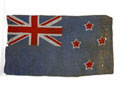
The Admiralty objected to the proposed use of the Blue Ensign 'for all purposes', as set out in the preamble to the bill. In the United Kingdom, the privilege of flying the Blue Ensign was reserved for government ships and other distinguished vessels. It was feared that this distinction would be watered down should the New Zealand bill be approved, as all New Zealand-registered merchant ships would then be granted the right to fly the Blue Ensign. The New Zealand government therefore agreed to restrict the use of the Blue Ensign at sea to 'vessels owned and used by the New Zealand Government', or where a warrant to fly it had been obtained from the Admiralty.

The earlier bill was replaced by a modified New Zealand Ensign Bill, which was passed by the House on 5 November 1901 after debate about whether the Southern Cross should have five stars as on the Victorian flag. King Edward VII approved the Act on 24 March 1902 and the Governor's proclamation to this effect was published in the New Zealand Gazette on 12 June 1902. A description of the flag followed on 27 June 1902, detailing alterations to the size and position of the stars. The Act was replaced by various Shipping and Seamen's Acts, including those of 1903 and 1908, but the provisions concerning the New Zealand flag remained effectively unchanged until the Flags, Emblems, and Names Protection Act 1981 came into force.


