

On Waitangi Day 2010 the national Māori flag flew for the first time over the Auckland Harbour Bridge. It also flew at Parliament, Premier House, the National War Memorial and on a number of other government buildings.
The origins of the flag
In 1989 the government allocated $20 million to commemorating the sesquicentenary (150th anniversary) of the signing of the Treaty of Waitangi. In response a coalition of Māori independence organisations, collectively known as Te Kotahitanga, agreed to seek ‘creative ways’ to inform Māori about breaches of the Treaty. Te Kawariki, an organisation based in the Far North, came up with the idea of running a competition for a national Māori flag, with the winning design to be ready in time for the 1990 commemorations.
The idea arose from a trip a group of Māori activists had made to Australia some years earlier. While in the country to support Aboriginal opposition to the 1982 Commonwealth Games in Brisbane, they visited Aboriginal activists in Redfern, Sydney. They were impressed by the prominent display of the Aboriginal flag by the Aboriginal community. In Te Kawariki's account of its activities, 20 years of protest action 1979-1999, Te Kawariki, one of its members describes the experience:
It was everywhere - on t-shirts, on flagpoles, on hats, on bags, on walls, and even spray-painted onto a couple of broken down cars on the road. A stunning and powerful symbol that required no words, no explanations, no descriptions. It was just there – in your face, behind your back, beneath your feet, waving above your head, and watching you from the sidelines. You just couldn't ignore it. The flag. It blew us away.
I remember vowing that one day we would have a flag of our own - a symbol of our struggle for Maori independence.
Te Kotahitanga endorsed the idea for a flag competition and Te Kawariki subsequently publicised it. Rather than advertising in the mainstream media, Te Kawariki used local iwi radio and the Black Power newspaper – which offered free advertising, but was also a Māori publication distributed around the country and in Australia.
After Te Kawariki decided that none of the designs submitted reflected what they were looking for, a collective of Māori women artists was asked for their input. Hiraina Marsden, Jan Dobson and Linda Munn created the design. It was shown at hui in the north before being hand-sewn by Jan Dobson. Posters carried an explanation of the meaning of the flag written by Walter Erstich.
The flag was launched shortly before Waitangi Day 1990 during a hīkoi from Te Rerenga Wairua (Cape Rēinga) to Waitangi.
The use of the flag
Te Kawariki claim that they ‘did not actively promote the flag’ but that ‘it travelled on its own’. They acknowledge that while some Māori adopted it, others hated it or preferred other designs. But the flag gained national visibility through the group's protest activities on Waitangi Day. According to Aroha Harris, author of Hikoi: forty years of Maori protest, from about 1985 Te Kawariki ‘developed a critical presence at Waitangi Day celebrations’. By the mid to late 1990s the group was producing the flag in a range of formats - including hats, badges, t-shirts and bumper stickers - with the words ‘Tino Rangatiratanga/Māori independence’. The proceeds funded protest activities and the work of CORSO Aotearoa.
In 1999 the Māori sovereignty flag made the headlines when protesters scaled the flagpole at the Waitangi Treaty Grounds and substituted it for the New Zealand flag. This action was repeated the following year. At the time Governor-General Sir Michael Hardie Boys was critical of the ‘few young hotheads’ who, he said, had raised the flag. But the veteran Māori activist Titewhai Harawira argued that the protesters had been quite right to protest at the lack of recognition for a Māori flag, which should fly next to the New Zealand flag.
Over the next decade the flag continued to appear at protests at the Waitangi Treaty Grounds and elsewhere on Waitangi Day. It was also flown at other protests around the country, such as the occupation of Whanganui’s Pākaitore (Moutoa Gardens) in 1995, and during the 2004 foreshore and seabed hīkoi.
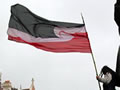
The flag made headlines again in February 2007 when Transit New Zealand, the organisation responsible for New Zealand’s main roads, refused a request by a Māori sovereignty group, Te Ata Tino Toa, to fly it on the Auckland Harbour Bridge on Waitangi Day. The government agency explained that its policy was to fly the New Zealand flag and, on request, the flags of other countries. But Te Ata Tino Toa argued that as ‘corporates’ (including yachting's Team New Zealand) had been allowed to fly their flags, it was a ‘disgrace’ that this ‘right’ was not extended to Māori.
The debate heated up again in May that year after Transit New Zealand allowed the flag of the European Union to be flown on the harbour bridge. Māori Party MP Hone Harawira argued that this was ‘hypocritical’ and said he would refer the matter to the Race Relations Office. Transit New Zealand subsequently admitted that it had erred in treating the European Union as a country and announced that it was reviewing its flag policy. This review resulted in a ‘simplified’ policy under which only the New Zealand flag would be flown.
Behind Australia
The Australian Aboriginal flag was originally designed as a protest flag in 1971. On 14 July 1995 it and the Torres Strait Islander flag were officially proclaimed as ‘Flags of Australia’ by the Australian government. Many buildings in Australia now fly the Aboriginal flag as well as the Australian flag.
In January 2008, with Transit New Zealand’s stance unchanged, Te Ata Tino Toa asked various organisations throughout the city, including the University of Auckland, to fly the Māori flag in the run-up to Waitangi Day.
The national Māori flag
In January 2009 Te Ata Tino Toa asked Māori Party co-leader Pita Sharples to support its application to Transit New Zealand to fly the flag on the Auckland Harbour Bridge. By this time the Maori Party was a coalition partner in a National-led government, and Sharples was the Minister of Māori Affairs. He promised to raise the issue with ministers but there was initial scepticism that the idea would gain traction. This rapidly changed once Prime Minister John Key said he had no objection to a Māori flag being flown from the bridge, if Māori could agree on a design. In appreciation of his stance Te Ata Tino Toa sent the Prime Minister a tino rangatiratanga t-shirt addressed to Hone Kei, Pirimia.
During July and August 2009, 21 public hui were held nationwide, and written and online submissions were invited from Māori and other interested New Zealanders. Four flags of national significance were identified for consideration as the preferred national Māori flag: the New Zealand flag; the New Zealand Red Ensign; the national (United Tribes of New Zealand) flag; and the Māori (Tino Rangatiratanga) flag.
More than 1200 submissions were received, with 79% of submitters identifying themselves as Māori. 80% of the submissions nominated the Māori (Tino Rangatiratanga) flag as the preferred national Māori flag. Most feedback indicated that it should be flown on Waitangi Day and other significant occasions.
On Waitangi Day 2010 the national Māori flag flew on the Auckland Harbour Bridge for the first time. It also flew at other nationally significant sites including Parliament, the Beehive, the National War Memorial, Te Papa, the National Library of New Zealand, and other government buildings. But there was far from universal support for the flag; some considered it too divisive and/or preferred to fly the United Tribes flag. It did not fly at the Waitangi Treaty Grounds, and Ngāi Tahu and Te Arawa did not support it being flown at official commemorations in their rohe.


