
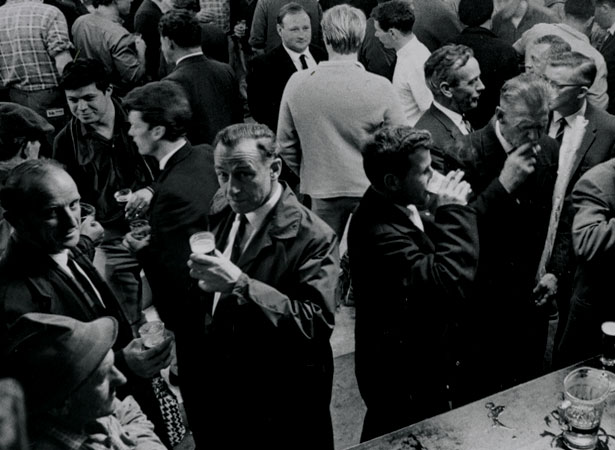
Fifty years of six o’clock closing of pubs had ended two days earlier, after a referendum convinced the government to change the antiquated licensing law.
Introduced as a ‘temporary’ wartime efficiency measure in December 1917, 6 p.m. closing was made permanent the following year.
The ‘six o’clock swill’ became part of the New Zealand way of life. In the short period between the end of the working day and closing time, men crowded together to drink as much beer as they could before bar service ended and 15 minutes of ‘supping-up’ time was announced.
A mood for change began to emerge in the 1960s. The growing restaurant and tourism industries questioned laws that made it difficult to sell alcohol with meals, while members of sports clubs and the Returned Services’ Association also sought a change.
When the government held a national referendum on 23 September 1967, 64.4% of voters supported a move to 'later closing, the actual hours of sale to be decided according to local conditions'. Most local authorities opted for pubs to open between 11 a.m. and 10 p.m., and the last six o'clock swill took place on Saturday 7 October. On Monday the 9th, a new era of more civilised drinking began.
Read more on NZHistory
Food in 20th century New Zealand – Food in the 20th centuryLife in New Zealand – Assisted immigration, 1947-75Voting for prohibition – Temperance movement1967 - key events – The 1960s
External links
How to cite this page
'First day of ten o'clock closing', URL: https://nzhistory.govt.nz/the-end-of-the-six-oclock-swill, (Ministry for Culture and Heritage), updated 7-Sep-2020


