See historic events for any day of the year by entering the date below. Why not try your birthday?

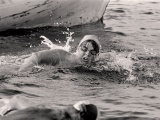
American Lynne Cox swam from the North Island to the South in a time of 12 hours 2 minutes and 30 seconds. She battled heavy seas and strong winds and on two occasions the Cook Strait cargo ferry Aratika hove to alongside the swimmer to protect her from the wind. The ferry flew the American flag as another gesture of support.
The 22.5 kilometre crossing of Cook Strait has always been a massive challenge to long-distance swimmers because of its treacherous tides and unpredictable weather patterns. Following the first unsuccessful attempts by R. G. Webster and Lily Copplestone in 1929, several other people tried but failed to conquer the strait. The first successful crossing was made by Barrie Devenport on 20 November 1962. The first non-stop double crossing was made by Phillip Rush on 13 March 1984. The current time record is held by Denise Anderson, who swam the strait on 20 January 1986 in five hours four minutes.
Image: Lynne Cox (Te Ara)

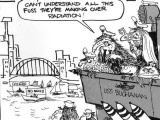
The New Zealand Labour government refused the USS Buchanan entry on the grounds that the United States would neither confirm nor deny that the ship had nuclear capability. David Lange's government, elected in July 1984, had made clear its intention to pursue policies that would establish New Zealand as a nuclear-free country. This was a popular stand, and by the end of the year nearly 40 towns and boroughs had declared themselves nuclear-free. Labour announced its decision to ban ships that were either nuclear-powered or armed. The US maintained its position, and stalemate was reached.
The US decided to test the new government's resolve in late 1984 when it requested a visit by the guided missile destroyer USS Buchanan. The Buchanan was an older ship, and the Americans hoped that public suspicions that it was not nuclear armed would be enough for it to slip under the political radar. 'Near-uncertainty was not now enough for us,' David Lange recalled. 'Whatever the truth of its armaments, its arrival in New Zealand would be seen as a surrender by the government.' He hoped that the Americans might offer to send something less ambiguous, but it was the Buchanan or nothing.
On 4 February 1985 the government said no. Within a matter of days Washington severed visible intelligence and military ties with New Zealand and downgraded political and diplomatic exchanges. US Secretary of State George Schultz confirmed that the United States was no longer willing to maintain its security guarantee to New Zealand, although the ANZUS treaty structure remained in place.
Image: USS Buchanan anti-nuclear cartoon