
What happened that day?

Kiwi of the Week

  • freyberg.biog.jpg

    Bernard Freyberg

    A First World War hero and commander of the 2nd New Zealand Expeditionary Force, Bernard Freyberg was British-born but New Zealand-raised. He proved to be a charismatic and popular military leader who would later serve a term as Governor-General

This WeeK's Quiz

Today in History

previous12 Decembernext

rss feed
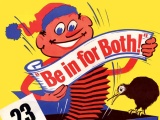
First Golden Kiwi lottery draw

1961 First Golden Kiwi lottery draw

A national lottery operated in New Zealand from 1932, but the prizes in the euphemistically named ‘art union’ were small. Many people continued to take part, illegally, in overseas lotteries. In an attempt to benefit from their popularity the government began to tax (and legitimise) some of these lotteries in the 1950s. But the tax revenue was paltry compared to what New Zealanders were spending.

Investigations undertaken by the Labour government (1957–60) suggested that the only way to meet the demands for increased funding from various community groups was to establish a lottery as attractive as those found overseas. But it was the National government elected in November 1960, with Leon Gotz as Minister of Internal Affairs, that took up the challenge. By March 1961 Gotz had a proposal, and a month later Cabinet gave this the go-ahead.

Gotz's Golden Kiwi lottery was a hit. Tickets went on sale on the morning of 4 December 1961 and all 250,000 had been sold by the following afternoon. The first prize of £12,000 was four times that offered in the art union lottery. With his winnings, Mr C. V. O'Connor could theoretically have bought ‘a three bedroom house in a middle class Wellington suburb, a new six-cylinder car, and [had] some spending money to boot'.

The Golden Kiwi was not without its opponents. Protestant groups who opposed lotteries had been ‘relatively mute’ during recent years. But the ‘glamorous, high profile and lucrative’ Golden Kiwi was seen as more dangerous than the art unions, which were viewed as ‘quiet, respectable and uncontroversial affairs run with philanthropic intent’. Presbyterian leaders, who were among the most critical, ordered their followers not to purchase tickets. But such opposition largely fell on deaf ears – one of the biggest complaints from the public was that there were not enough tickets on sale. A black market even developed.

A more significant problem was how to distribute the profits. Since the establishment of the art union in 1932 the Minister of Internal Affairs had held a monopoly on this. But with more money at stake Gotz was inevitably accused of ‘political patronage’ and even dishonesty. To combat these accusations an independent committee and six specialist grants boards were established. It would prove to be a new era in dispensing lottery funds.

Like its predecessors, the Golden Kiwi eventually lost the public's interest. Despite various facelifts during the 1960s and 70s, its popularity and profits waned. It survived until 1989, by which time New Zealanders had embarked on a new love affair with Lotto.

De Surville first sights NZ near Hokianga

1769 De Surville first sights NZ near Hokianga

As James Cook rounded the northern tip of the North Island, the French explorer Jean François Marie de Surville was in the same waters. A storm prevented an historic meeting with Cook.

Image: satellite view of northern tip of New Zealand.