What happened that day?

Kiwi of the Week

  • freyberg.biog.jpg

    Bernard Freyberg

    A First World War hero and commander of the 2nd New Zealand Expeditionary Force, Bernard Freyberg was British-born but New Zealand-raised. He proved to be a charismatic and popular military leader who would later serve a term as Governor-General

This WeeK's Quiz

Today in History

previous17 Decembernext

rss feed
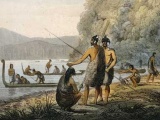
Ten crew of Cook's ship <em> Adventure </em>  killed and eaten

1773 Ten crew of Cook's ship Adventure killed and eaten

At Wharehunga Bay, Queen Charlotte Sound, 10 men who were with James Cook's navigator Tobias Furneaux died at the hands of Ngati Kuia and Rangitane, led by their chief, Kahura.

Cook himself was aboard the Resolution and had left the Sounds three weeks before the arrival of Adventure. (The two ships had become separated several months earlier during a fierce storm and it was hoped they would be able to meet at Ship Cove.) On 17 December Furneaux ordered 10 men to go ashore to collect wild greens for the crew. They sailed on a cutter with the master's mate, Jack Rowe, in charge. Their orders were to return by mid-afternoon, but by nightfall there was still no sign of the cutter.

Next morning Lieutenant Burney and ten armed marines set off in a launch to search for the missing cutter and its crew. When they got to a small beach next to Grass Cove they spotted a large double-hulled waka (canoe) hauled up on shore. Inside the waka they found one of the cutter's rowlocks, a shoe belonging to one of the crew, and what they thought was dog's flesh. In Between worlds, Anne Salmond describes the scene:

Nearby on the beach they saw about twenty food baskets tied up. When they cut these open, they found them packed with roasted meat and fernroot, still warm from the fire. Burney hoped that this might also be dog's flesh, but soon they found more shoes and a hand tattooed 'TH'. This was unmistakeably the hand of Thomas Hill .... Behind the beach they saw a circle of freshly dug ground about four feet in diameter, almost certainly a hangi or earth oven.

The crew hurried back to their launch and rowed to Grass Cove, where they found an estimated 1500-2000 Maori gathered. Some of the crowd taunted the marines, who responded by firing into the crowd, which quickly dispersed. On the beach they found one of the cutter's oars and 'such a shocking scene of Carnage & Barbarity as can never be mentioned or thought of, but with horror':

Dogs were chewing at the discarded entrails of four or five men, and they found the eyes, hearts, lungs, livers and heads of their comrades ... various feet and Rowe's left hand (identified by its scarred forefinger) roasting on fires or scattered on the ground.

Burney's crew had probably interrupted a whangai hau ceremony, in which an enemy is sacrificed to the ancestors. The crew quickly gathered up some of the body parts and hurried back to the launch, firing some parting shots and destroying three waka on the beach.

Although nobody knows why the Europeans were attacked, Burney concluded that there was probably no premeditation. There had been a few minor incidents and misunderstandings in the days before 17 December. Jack Rowe, who had previously tried to kidnap local people at Uawa, may have started a quarrel that  got out of hand. Returning to the area on his third voyage, James Cook seems to have been satisfied that no retaliatory action was required after meeting Kahura and other Ngati Kuia.

Major Major, mascot of 19 Battalion, dies of sickness

1944 Major Major, mascot of 19 Battalion, dies of sickness

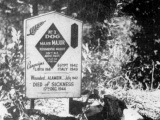
Major Major, No. 1 Dog, 2NZEF, and member/mascot of 19 Battalion since 1939, died of sickness in Italy. He was buried with full military honours at Rimini.

Major was a white bull terrier who served with distinction in North Africa and Italy. He attained the rank of Major in September 1942, shortly after receiving a shrapnel wound at El Alamein.

Image: Major Major sitting in front of officers of 19 Battalion