What happened that day?

Kiwi of the Week

  • freyberg.biog.jpg

    Bernard Freyberg

    A First World War hero and commander of the 2nd New Zealand Expeditionary Force, Bernard Freyberg was British-born but New Zealand-raised. He proved to be a charismatic and popular military leader who would later serve a term as Governor-General

This WeeK's Quiz

Today in History

previous27 Novembernext

rss feed
Liner sunk by German raiders off East Cape

1940 Liner sunk by German raiders off East Cape

The 16,712-ton New Zealand Shipping Company liner MV Rangitane was sunk by two German 'auxiliary cruisers' (armed merchant raiders), the Orion and Komet, 300 nautical miles off East Cape. The British-owned liner was the largest Allied merchant ship to be sunk by a German surface vessel during the Second World War (although German submarines and aircraft sank many larger ships).

Two days after sinking the little steamer Holmwood off the Chatham Islands, the Orion and Komet (cruising with an unarmed supply ship, the Kulmerland) intercepted the Rangitane, which had just left New Zealand for the UK via Panama. The ship had a crew of 201 and was carrying 111 passengers, including Fleet Air Arm recruits and radar specialists bound for Britain, and a group of British women who had earlier escorted 477 child evacuees to New Zealand aboard SS Batory. A trainee airman, Alan Jones, recalled the attack:

Half past three in the morning, the clanging of sirens was going, and there were big crashes ... I went up on deck, and there was one of the raiders on each side of us, and the supply ship in front. You could see some of the shells ricocheting off. To hell with that, so we went down below again. I was a bit scared, a bit bewildered. Then there was another salvo and one of the saloons was on fire ... There was the smell of cordite, and the ship would shudder every so often when it was hit.

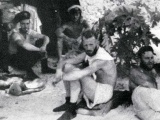
Seven passengers were killed or died later of wounds, including four female child escorts. Eight crew members were also lost, including two stewardesses and two brothers who were both engine-room hands. (Some sources erroneously claim there were only 11 deaths.) The 300 survivors were taken aboard the German ships. Most of the captives were later landed on Emirau Island in the Bismarck Archipelago (near Papua New Guinea), from where they were repatriated to Australia in January 1941. A number of merchant seamen and servicemen, including Alan Jones, were eventually interned in Germany.

Image: Survivors of the Rangitane (Te Ara)

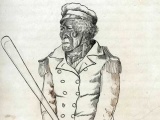
Death of Te Rauparaha

1849 Death of Te Rauparaha

The formidable Ngati Toa leader, sometimes called the 'Napoleon of the Southern Hemisphere', had ruled the lower end of the North Island from his base at Kapiti Island for the best part of 20 years.

Te Rauparaha spent the last year of his life at Otaki. By this time his influence appears to have declined, possibly because of the humiliation of his imprisonment by Governor Grey in 1846. He had had eight wives in the course of his life, and 14 children, some of whom survived him. He was buried near the Rangiatea church in Otaki. He is believed to have later been reinterred on Kapiti.

Image: detail from sketch of Te Rauparaha (1847).