See historic events for any day of the year by entering the date below. Why not try your birthday?

On the evening of 18 December Abel Tasman and his men had the first known European encounter with Maori. Although this initial meeting was peaceful, the misunderstanding and fear aroused by two such different worlds coming together soon led to violence.
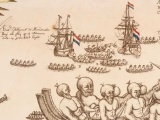
Tasman had first sighted New Zealand on 13 December. His flagship, the yacht Heemskerck, and an armed transport ship, the Zeehaen, had sailed up the West Coast, reaching Cape Farewell on the 16th. On the 18th they anchored at Wharewharangi Bay, near Wainui Inlet to the north of what is now Abel Tasman National Park. They were about four miles from the shore.
The local inhabitants were Maori of Ngati Tumatakokiri. They probably spent the day deciding how to respond to the strange visitors. Eventually two waka (canoes) of warriors paddled out to inspect the ships more closely. The Maori challenged the intruders with ritual incantations and blasts of their shell trumpets, possibly in an attempt to frighten away what they saw as spirits or ghosts.
In response the Dutch, who had noticed the lights on the shore and watched the waka approach, shouted and blew their own trumpets. They then decided to fire a cannon, which according to an account from the Dutch ship's barber-surgeon (published in Anne Salmond's Two worlds), provoked an angry reaction:
The Southlanders [Maori] began to rage terribly, tooting on a horn, and returned to land. Tasman ordered a watch kept, and equipped the rest with swords, pikes and muskets.
The next day seven waka came out to the Dutch ships. The Heemskerck's small boat was sent to the Zeehaen to warn the crew to be on their guard and not to let too many on board. While returning to the Heemskerck, the boat was rammed by a waka and the sailors were attacked with paddles and 'short thick pieces of wood'. Three were killed and one mortally wounded. One of the dead was taken by the attackers, and the waka sped back to shore out of range of the muskets and cannon which opened fire from both ships.
As the Dutch ships weighed anchor and set sail, 11 waka approached and were fired on. The leading boat and one of its occupants were struck by canister shot. Tasman named the place Moordenaers (Murderers) Bay. It is now called Golden Bay.
It would be another 127 years before the next recorded encounter between European and Maori following Captain James Cook's arrival in New Zealand in October 1769.
Image: Isaac Gilsemans, 'A view of the Murderers' Bay', 1642