
Early New Zealand aspirations in the Pacific
Even as a fledgling British colony, New Zealand turned its gaze towards the Pacific. From the 1840s, early New Zealand politicians such as Sir George Grey (1812–98), Sir Robert Stout (1844–1930) and Sir Julius Vogel (1835–99) actively promoted a vision of New Zealand as the centre of a great South Pacific empire.
As a small, remote and under-populated British colony, New Zealand was vulnerable. It wanted economic stability and security against invasion. It wanted Britain to extend her control of trade routes and prevent rival imperial powers such as France and Germany from increasing their influence in the region.
Grey, Stout and Vogel advocated ambitious policies of expansion in the Pacific. But their persistent calls for British annexations in the region, particularly of the larger island groups of Samoa and Fiji, were rejected by London’s reluctant and often dismissive Colonial Office.
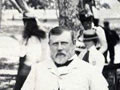
During the 1890s, Premier Richard Seddon (1845–1906) actively promoted New Zealand as the ‘Britain of the South Pacific’. Like those before him, ‘King Dick’ believed that New Zealand’s geographical position and its experience governing Māori made it ideally suited to administer other Pacific territories on behalf of Britain.
Seddon was angry when Britain agreed to the United States’ annexation of Hawaii in 1898. He was furious at the ‘great betrayal’ the following year, when Britain allowed Samoa to be partitioned between Germany and the United States. In 1900, his carefully staged ‘health cruise’ around the Pacific sought evidence to persuade the Colonial Office that the inhabitants of the Cook Islands, Niue, Fiji and Tonga desired New Zealand annexation.
Seddon’s efforts seemed rewarded when, in 1901, Britain allowed New Zealand to annex the Cook Islands and Niue. However these were not the prizes imperialists hoped for. New Zealand’s first Pacific acquisitions were ‘a remote and worthless group’, according to the Colonial Office.
German Samoa
The Samoan archipelago comprises six main islands, two atolls, and numerous smaller islets located in the south-west quadrant of the Pacific Ocean. Its closest neighbours, the northern members of the Tonga group, are 210 km to the south-west.
Samoans were not consulted when Britain, Germany and the United States agreed to partition their islands in December 1899. Germany acquired the western islands (Savai’i and ‘Upolu, plus seven smaller islands), while the United States acquired the eastern islands (Tutuila and the Manu’a group) and established a naval base at Pago Pago.


