
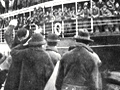
With hindsight, New Zealand’s capture of German Samoa on 29 August 1914 was an easy affair. But at the time it was regarded as a potentially risky action with uncertain outcomes. As it happened, New Zealand had a great deal of luck on its side.
At the outbreak of war, Samoa was of moderate strategic importance to Germany. The radio transmitter located in the hills above Apia was capable of sending long-range Morse signals to Berlin. It could also communicate with the 90 warships in Germany’s naval fleet. Britain wanted this threat neutralised.
Before the Anzacs
While the landing at Gallipoli on 25 April 1915 witnessed the birth of the Anzac legend, the first Australian–New Zealand military operation of the First World War was actually the capture of German Samoa in August 1914.
After agreeing to seize the territory, New Zealand asked for details of German troop numbers and fortifications. British military intelligence would have been able to report that German Samoa’s defences were limited to a native constabulary of about 50 men with two European superintendents. (An often-repeated claim that London responded with, ‘For information regarding the defences of Samoa see Whitaker's Almanac’, is now considered untrue.)
New Zealand’s troops were vulnerable as they crossed the Pacific. The ships Monowai and Moeraki, requisitioned from the Union Steam Ship Company as transports, were slow and unarmed. After sailing from Wellington on the morning of Saturday 15 August, they rendezvoused with HMS Philomel, Psyche and Pyramus. These aging British cruisers were initially their only escorts.
The danger to the New Zealand convoy was real. At the outbreak of war, Germany had two heavy cruisers, SMS Scharnhorst and SMS Gneisenau, three light cruisers and various other ships stationed in the Pacific. Throughout the two-week voyage to Samoa, the location of the German East Asia Squadron remained unknown to the Allies.
Naval support was strengthened after five days when the New Zealand convoy reached Noumea in French New Caledonia. There they were joined by the Royal Australian Navy’s battlecruiser HMAS Australia, the light cruiser HMAS Melbourne and the French armoured cruiser Montcalm. In his diary, trooper John Reginald Graham describes the tension on board ship after leaving Noumea:
22 Sat – left [at] daylight & when about 300 miles out sighted steamer in distance but proved to be a British collier… The sighting of this ship caused great excitement as we all thought it was a German…
It was only on reaching Samoa that New Zealand realised the weakness of the German defences: 20 troops and special constables armed with 50 aging rifles. The single artillery piece at Apia was fired every Saturday afternoon but took half an hour to load. It was later discovered that the German administration had received orders from Berlin not to oppose an Allied invasion.
The Samoa Advance Party of the New Zealand Expeditionary Force landed at Apia on 29 August with no opposition. But had Germany placed greater importance on Samoa, or had the German East Asia Squadron intercepted the New Zealand convoy en route, the story could have been very different.
A fortnight later, on 14 September, the Scharnhorst and Gneisenau arrived off Apia and the New Zealand garrison braced itself for large-calibre gunfire. Luckily, the cruisers left once their skippers realised that Samoa was no longer in German hands. They raided Tahiti on 22 September, sinking a French gunboat and bombarding Papeete.


