
British, Australian and Japanese warships quickly sank or neutralised the German cruisers which were in the Pacific and Indian Oceans at the outbreak of the First World War. That largely removed the need for the New Zealand government to intervene much beyond chartering vessels as transports and hospital ships. Not until January 1917 did it ban the press from reporting shipping movements – and even then, this ban only applied to ships bound for the northern hemisphere.
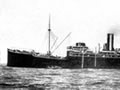
New Zealand was out of reach of German U-boats, so the only ship to raid local waters was the auxiliary cruiser (converted freighter) SMS Wolf. In June 1917 it seized and sank two ships, the Union Company’s Wairuna and an American schooner, off the Kermadec Islands. Mines it laid off the New Zealand coast later claimed two more vessels. On 18 September 1917 the Port Kembla struck one and sank off Cape Farewell, without loss of life. Then on 26 June 1918 the trans-Tasman liner Wimmera sank off Cape Maria Van Diemen in the Far North, with the loss of 26 lives.
The most obvious impact on our waterfronts was a reduction in the number of ships arriving from Britain as their use was rationalised. Late in 1916 a Shipping Controller took over the routing of the more valuable ships, including most ‘Home boats’, since refrigerated cargo liners were scarce. The policy worked. In 1918 the tonnage of overseas ships entering our ports was about half that of four years earlier, but the value of exports actually rose. Clearly, the companies were making better use of their resources, even if this displeased many exporters. The expensive refrigerated ships dominated the South American and Australasian runs and were not easy to replace. When the Shipping Controller prioritised the shorter South America-UK run, cargo built up in New Zealand warehouses and farmers complained, since they got paid on delivery to the ship, not the store.
Even trans-Tasman and coastal shipping was rationed, with the Moeraki maintaining a skeleton Tasman service for the Union Company after the Maheno, Manuka, Marama, Maunganui and Ulimaroa were taken up for war service. The smaller harbour boards were unhappy: coasters totalling 181,000 tons had called at Ōamaru in 1912; by 1918 the tonnage had dropped by more than 60%, to just 70,000.
Recycling Rotten Row’s relics
To fill gaps caused by sinkings and requisitions, several old hulks were pulled from ‘Rotten Row’, rebuilt and returned to service.
One curious revival was the old 1882 dredge Progress, converted into a stationary pontoon by the Oamaru Harbour Board just before the war. In 1916 Port Chalmers shipwrights bought it to convert to a sail trading ship. Later converted again to a steamer, the vessel lasted until 1931, when it was wrecked off Wellington.
Every wool season, George H. Scales of Wellington hired a few ships for farmer clients to carry their wool to Europe. When the charter market dried up, he bought three old sailing ships to convert into coal hulks to tide him over the war years. But when a survey revealed it would cost as much to strip them as to re-rig them, Scales returned the barques Rona, Louisa Craig (soon renamed Raupo) and the smaller Ysabel to service.
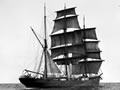
For nearly three years, the Rona and the Raupo carried coal across the Tasman or crossed the Pacific to San Francisco with cargo previously carried by steamers – hemp, flax and kauri gum to the north, and cased oil south. The Raupo made five round trips to San Francisco over 2½ years, introducing many young New Zealand seamen to a vanished way of life.
The demand for tonnage is great … the once despised ‘windjammer’ is in request.
Another ship saved from hulking was the 1866 clipper ship Antiope. When it came to Wellington in 1915 the Otago Iron Rolling Mills Company bought the vessel for deep-sea trading. It initally shipped timber and scrap iron across the Tasman, but later sailed as far afield as Peru and California. On one run into San Francisco, the Antiope overhauled a modern Japanese passenger liner and entered port 20 minutes ahead of it.


