
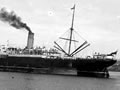
Many of the British-owned Home boats that linked New Zealand with the UK were lost during the First World War. Less than a fortnight after war broke out, on 16 August 1914, the New Zealand Shipping Company's Kaipara was captured and sunk by the German auxiliary cruiser Kaiser Wilhelm der Grosse near Tenerife. Losses mounted alarmingly in 1917-18 when Germany stepped up its submarine warfare against Allied commerce. One action stood out, the epic 1917 battle between the same company's Otaki and the German auxiliary cruiser Moewe (‘Seagull’).
Both were merchant ships, but there the similarity ended. The newly built 9800-ton Moewe carried four 150-mm guns, a 105-mm gun, two smaller pieces, torpedo tubes and mines. All were concealed, for the ship operated disguised as a merchant ship. It carried a highly trained naval crew of 235 and was fitted with sophisticated radio gear. In contrast, the 7420-ton Otaki (built in 1908) had been given two Royal Navy gunners to man its stern 4.7-inch (120-mm) gun. This lone weapon could throw a shell less than half the weight of one from the Moewe’s guns. At heart, the Otaki remained a humble food carrier, crewed by 71 civilians.
The Moewe’s commander bore the imposing moniker Korvettenkapitan Niklaus Graf und Burgraf du Donna-Schlodien. A naval man to the core, he had served in the Kaiser’s navy since 1896 and had been the navigator of a battleship prior to taking charge of the Moewe. The Otaki’s Scottish master, 39-year-old Captain Archibald Bissett-Smith, was about the same age and an equally experienced seaman, but in the merchant marine.
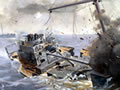
They crossed each other’s paths early in the afternoon of 10 March 1917 off the Azores in the North Atlantic. The Moewe had sunk a British freighter that morning and its officers went swiftly to action when they sighted another ship in murky conditions. Squalls and rising seas made pursuit difficult, but the Moewe had a slight speed advantage and closed the gap.
Even after the Moewe broke out its battle ensign and turned to clear its firing lines, Bissett-Smith refused to back down. Instead, his gunners sent a round sailing above the raider’s bridge. In the gunnery exchange that followed, the Otaki did surprisingly well. But the British ship had no chance and sank stern-first a few hours later, still flying its colours and taking Bissett-Smith with it. Five of his crew were killed; the survivors were taken prisoner. The Moewe, though, was also on fire and in danger of sinking. Donna-Schlodien averted disaster by cutting holes in the ship’s side to flood a bunker fire. The Moewe spent two highly vulnerable days wallowing on the high seas before it was repaired sufficiently to resume its raids on Allied shipping.
Only after the war, when the Otaki survivors were released, did the full heroism of the incident emerge. In 1919, in a rare move, the King awarded Captain Bissett-Smith a posthumous Victoria Cross, the conditions for the award having been met by retrospectively giving him status as a temporary lieutenant in the Royal Naval Reserve. Several other crewmen were also given awards or mentioned in despatches.
Bissett-Smith and the Otaki subsequently entered the folklore of the Merchant Navy. In 1937 his family presented the Otaki Shield to his old school, Robert Gordon’s College in Aberdeen. It is awarded to the boy with the highest qualities of character, leadership and athletic ability. To honour Bissett-Smith’s connection with New Zealand (as well as sailing for the New Zealand Shipping Company, he had married a Dunedin woman in 1914), the company added a travelling scholarship to the prize. The New Zealand government funded the Otaki Scholar’s stay in this country. Every year since then, apart from during the Second World War, the Otaki Scholar has visited New Zealand.


