
The South African War began just six years after New Zealand women had gained the right to vote, and provided further opportunities for them to assert their independence. Many did this by actively participating in fundraising, while some expressed public opposition to the war. A small number of women played a more direct role, choosing to serve as teachers or nurses in South Africa.
Teachers
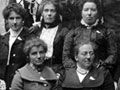
As a result of their imprisonment in concentration camps, Boer children were initially deprived of any education. In response to concern about this the British authorities permitted the establishment of schools. Edmund Beale Sargant, the acting director of education in South Africa, believed that British teachers could influence Boer children to accept British culture and grow up as willing citizens of the British Empire. With the headmaster positions already taken by men, female teachers were recruited from the colonies.
New Zealand's Education Act 1877, which granted free education to all children of both sexes, had led to a steady increase in the number of female teachers in New Zealand. By 1902 they outnumbered male teachers. Advertisements for female teaching positions in South Africa attracted 222 applicants.
The women who applied did so out of a sense of adventure rather than to advance their careers. Unmarried and without children, they were all over the age of 25 and many were considerably older. A total of 20 women were selected. Their group was named the ‘Learned Eleventh’ by Acting Premier Sir Joseph Ward in reference to the 10 military contingents that had preceded them. They departed for South Africa on 4 May 1902 aboard the SS Westralia.

Upon arrival in South Africa they were deployed to camps at Merebank, Jacobs Siding, Pinetown, Wentworth and Volksrust. Although conditions in the camps had improved, the teachers still experienced hardship. During the day it was intolerably hot inside the tents; strong winds sometimes caused tents to collapse. Forced by Victorian modesty to dress ‘suitably’ at all times, the teachers found that red dust constantly stained their white clothing.
When the camp system was dismantled, the teachers found jobs at schools in the towns or countryside. Most decided to remain in South Africa after finishing the term of their appointment. Only six of the 20 teachers returned to New Zealand, changed forever by their experiences in South Africa.
Nurses
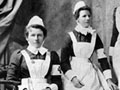
The war took place at a time when the profession of nursing in New Zealand was undergoing changes. Nurses had long been stereotyped as either incompetent old ladies or young society women looking for a ‘hobby’. By the end of the 19th century untrained nurses in New Zealand were being replaced by those who had received training in hospitals under the supervision of British-qualified superintendents.
The British government allowed New Zealand to send only trained nurses to South Africa. Officially the New Zealand government sent 13 nurses to serve, and it covered travel costs for only six, from Christchurch. Nurses from Otago and Southland nurses relied on fundraising. Other New Zealand nurses who were already working in England made their own way to South Africa as part of the Army Nursing Service Reserve (ANSR).
While serving in the ANSR the New Zealanders wore the emblem of a fern leaf above their red cross armbands to distinguish themselves from nurses of other nationalities. Because service records are incomplete, the total number of New Zealand nurses who served in South Africa is unclear but estimated at about 30. A few of the nurses fell ill, but none died while serving in South Africa.
While the British nurses received a gratuity upon completing their service, their New Zealand counterparts were forced to repeatedly appeal for the £37 10s (equivalent to nearly $6500 in 2016) to which they were entitled. They were granted this in 1903. Having gained experience in the field in South Africa, some of the nurses went on to serve in the First World War.


