
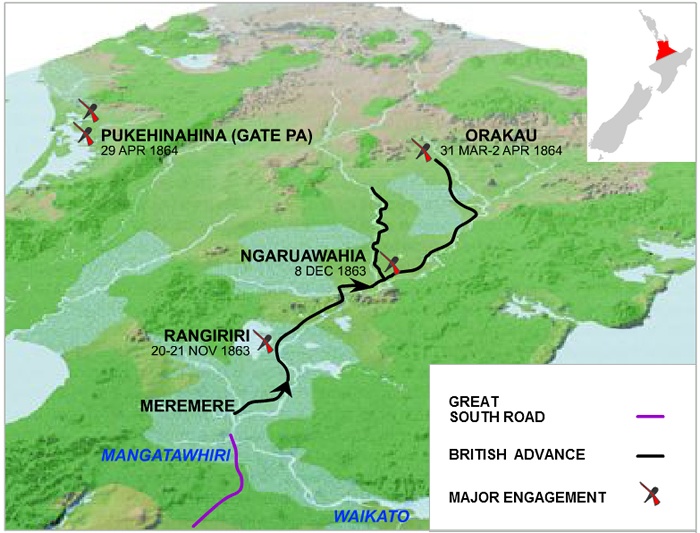
On 12 July 1863, Lieutenant-General Duncan Cameron’s forces crossed the Mangatāwhiri Stream and invaded Waikato. Adapted from plate 38 of the New Zealand historical atlas (Bateman, 1997), this map is oriented to the troops’ direction of travel, with north at the bottom.
After his return as governor in 1861, George Grey decided that the Kīngitanga, with its determination not to sell land, presented a serious challenge to imperial authority.
In 1862 and 1863 troops extended the Great South Road from Auckland and built a string of redoubts as a forward base for the invasion. Between July 1863 and April 1864 imperial troops, accompanied by locally raised Pākehā units, advanced as far south as Kihikihi.
Major battles were fought at Rangiriri on the Waikato River and at Ōrākau on the southern edge of the central Waikato district, which was occupied by British troops. Māori from lower and central Waikato took refuge in lands to the south and east. The conflict also spread into Bay of Plenty in 1864.
The Waikato campaign was the largest and most successful of the British military operations in the colony between 1845 and 1866. Although one of the government’s main aims was achieved – the Waikato basin was largely cleared of Māori for European settlement – the King movement was not vanquished.


Community contributions