
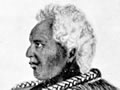
A few weeks after the battle of Ruapekapeka, the rival Ngāpuhi leaders met at Kawakawa and agreed to stop fighting among themselves. Hōne Heke and Te Ruki Kawiti lacked the resources to continue the war.
Many on the British side also realised how difficult it would be to keep fighting. The inconclusive outcome at Ruapekapeka offered both sides a way out. For Governor George Grey it was important to bring the war to a rapid conclusion to reverse the flight of settlers from Auckland. He chose not to re-erect the flagstaff at Kororāreka. His actions may have been magnanimous, but they also showed that he knew how hard it would be to achieve a total victory. While he spoke publicly of victory, he convinced his superiors of the need to retain troops in New Zealand.
Historian James Belich contends that Grey won the propaganda war while Kawiti and Heke won the war on the battlefield. Others argue that Belich’s revisionism goes too far and maintain that Grey’s decisive action sent a powerful message to Kawiti and Heke about the nature of their new opponent. Grey showed his diplomatic skills when he pardoned the ‘rebels’ and did not confiscate any land. Some argue that Ngāpuhi’s neutrality during the 1860s can be attributed to Grey’s diplomacy in the aftermath of the Northern War.
Grey largely ignored the main reasons for Kawiti and Heke’s protest – their wish for partnership in government and control over their lands. While peace was formally made with Kawiti in mid-1846, Grey and Heke did not meet until 1848, when Grey was presented with Heke’s greenstone mere. According to Heke’s biographer, Freda Kawharu, this was ‘a token of acceptance of Grey’s right to be in New Zealand and of Heke’s expectation that the Queen’s representative would honour the treaty.’


