
Governor George Grey had convinced his superiors of the need for more men. A force of around 1300 British troops and 400 Māori began to advance on Ruapekapeka in early December 1845.
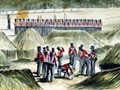
After hauling 30 tonnes of artillery and supplies over nearly 30 km of rugged country, the British force assembled before Ruapekapeka – ‘the bat’s nest’. The highly intricate pā with tunnels, rifle pits and trenches was surrounded by a strong palisade, but its garrison was outnumbered four to one. The British had three naval 32-pounder cannon, an 18-pounder, two howitzers and a number of mortar and rocket tubes. Te Ruki Kawiti had an ancient 12-pounder (which was destroyed shortly after the British began shelling the pā) and a 4-pounder.
Hōne Heke, who had recovered from his wounds, joined Kawiti inside Ruapekapeka with 60 reinforcements during the night of 9 January 1846. He and Kawiti now had a combined force of perhaps 500.
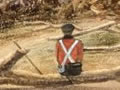
A full-scale bombardment on 10 January created three small breaches in the palisade. Despard was keen to attack before Kawiti’s men could escape but was talked out of this course of action by Wāka Nene and Grey.
The end of the battle is shrouded in controversy. The following day, 11 January, scouts discovered that only Kawiti and around a dozen men were still inside the pā. When troops attacked, this group fled into nearby bush after firing a volley. When the British followed they were fired on from hidden positions. Fighting intensified briefly and Kawiti’s men seemed to be trying to retake the pā. The conflict fizzled out when the British refused to be lured into the bush. A dozen British had been killed, and rather more Māori. Some of the British may have been shot by their own side as they scoured the pā for non-existent loot.
Despard and Grey proclaimed a ‘brilliant success’. Despard boasted that Ruapekapeka had been ‘carried by assault’ and that a full-sale attempt to regain it had been repulsed. Grey used Ruapekapeka to establish his credentials with a Pākehā community in need of reassurance about who was in control of New Zealand.
Why was Ruapekapeka abandoned?
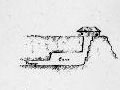
The fact that no provisions or ammunition were left behind in the pā suggests that this was an organised withdrawal. The pā may have served its purpose and been abandoned. The defenders may also have hoped that the soldiers would be drawn into an ambush by Heke and his men in the dense bush outside the pā. On the other hand, Kawiti and his men may have taken what they saw as their best chance to escape.
A contemporary theory was that the Christian Māori had left the pā to hold a Sunday prayer service while Kawiti, a non-believer, had stayed inside with a handful of his men. The garrison was then caught off-guard. But when the same forces had met at Ōhaeawai, there had been no such acknowledgement of the Sabbath.
To the British, the capture of such an intricately designed and well-constructed pā was a significant achievement – a tactical victory. But many consider the battle to have been drawn. Heke and Kawiti had escaped with their forces largely intact, and the terms of the subsequent peace settlement suggest that they may even have won a strategic victory.


