
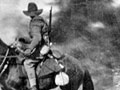
Following the British annexation of Transvaal in October 1900, the conflict in South Africa entered a second phase: guerrilla war. Although the British controlled the towns and railway lines, the Boer commandos were still able to operate on the veldt, where they were supported by their families. They knew the terrain well and used its features to their advantage. Kopjes (hills) and dongas (riverbeds) suited Boer marksmen as they provided natural cover in an otherwise open landscape.
To counter this advantage, General Lord Kitchener, the British military commander in South Africa, instigated a new strategy of using mobile columns to hunt down the remaining Boers. Most Boer families were eventually removed from their farms and interned in what were soon called ‘concentration camps’. Disease was rife in these crowded camps and many Boer civilians died. Farm livestock was either seized by the British or slaughtered.
Towards the end of 1901 Kitchener and Lord Alfred Milner, the British High Commissioner for Southern Africa, devised a new strategy to bring the war to a successful conclusion. Rather than remove the women and children to concentration camps, the British decided to leave them in the ruins of their former farms so that they would become a burden on their menfolk. To secure the countryside, lines of blockhouses were constructed and linked by fences of barbed wire. Nearly 8000 blockhouses had been built by the end of the war, linked by 6000 km of wire. The mounted columns now drove any Boers they encountered towards the blockhouses, which were manned by armed garrisons. Cut off from any possible escape, the Boers were forced to surrender.
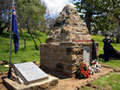
The last major engagement involving New Zealand troops took place as a result of these blockhouse drives. Pursued by the imperial forces, the leaders of the Orange Free State, President Steyn and General Christiaan De Wet, decided to break through the lines being held by the New Zealand Seventh Contingent at Langverwacht Hill. On the night of 23 February 1902 the Boers overwhelmed the New Zealand posts and opened a gap in the line large enough for them to escape through. The 80 New Zealanders fought gallantly; 23 were killed and another 40 wounded.
The last New Zealander to die in action was Lieutenant Robert McKeich of the Ninth Contingent on 4 June 1902, four days after the signing of the peace treaty. When McKeich and Lieutenant Henry Rayne rode out into the countryside to hunt, they were confronted by three Boers who refused to believe that the war was over. When he physically resisted a demand that they hand over their clothes and weapons, McKeich was shot dead. Rayne escaped after killing one of the Boers and wounding the other two, one of whom later died of his wounds.


