
The Battle for Crete was one of the most dramatic battles of the Second World War. Over 12 days in May 1941 a mixed force of New Zealanders, British, Australian and Greek troops desperately tried to fight off a huge German airborne assault. Despite suffering appalling casualties, the parachutists and glider-borne troops who led the invasion managed to secure a foothold on the island and eventually gained the upper hand. The battle ended with the evacuation to Egypt of the bulk of the Allied force.
Greek campaign
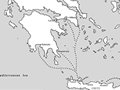
Crete became a German target following their rapid occupation of the Greek mainland in April 1941. German forces had surged into the Balkans, quickly defeating Yugoslavia and outflanking Greek border defences. The 2nd New Zealand Division – part of a Commonwealth force hastily deployed to help the Greeks – was soon in the thick of the action. Outgunned and outnumbered, it was forced to conduct a fighting withdrawal south through Greece. During the last week of April more than 50,000 Allied troops were evacuated from the mainland, including most of the 2nd New Zealand Division. In this brief campaign nearly 300 New Zealanders were killed and 1800 captured.
Attention now turned to Crete. The German High Command debated whether to seize the island or focus efforts on the planned invasion of the Soviet Union. Capturing Crete would have its advantages. It would both give the Germans a good base in the eastern Mediterranean and prevent the British using it to mount operations in the Balkans. A seaborne invasion ran the risk of disruption by British naval forces, but the Germans could also call on highly trained airborne forces. After being assured that it would not seriously disrupt his plans in Eastern Europe, Adolf Hitler reluctantly agreed to the invasion of Crete – Operation Merkur (Mercury).
To Crete
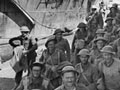
Most of the Allied troops evacuated from Greece were sent to Crete. By the end of April there were more than 42,000 British, Commonwealth and Greek soldiers on the island. This force included the bulk of the New Zealand Division (7700 men). One brigade had gone directly to Egypt and it was expected that those on Crete would quickly follow. But faced with shipping shortages and the threat of German attack, the British decided to use the men already on the island for its defence.
On 30 April command of ‘Creforce’ – the designation for the Allied troops on the island – was entrusted to Major-General Bernard Freyberg, who led the 2nd New Zealand Expeditionary Force (2NZEF). He faced a daunting task. During the withdrawal from Greece the British had been forced to abandon their heavy equipment and transport. Most soldiers arrived on Crete with little more than their personal weapons. Ammunition and stores were in short supply, and a lack of tools saw troops digging defensive positions with steel helmets. Heavy weapons – tanks and artillery – were few and far between. Air support was also scarce as the Royal Air Force (RAF) was preoccupied elsewhere in the Mediterranean.
Geography also made the job of defending Crete tough. The key points on the island were the airfields at Maleme, Retimo and Heraklion, and the port at Suda Bay. All were located on the northern coast and faced German-occupied Greece – at its nearest point little more than 100 km away. The loss of any of these positions would make the defence of the island virtually impossible, given the Germans’ ability to quickly deliver men and supplies from bases on the mainland. Yet the British were unwilling to destroy them – the port at Suda Bay was essential to the supply of Creforce, and it was still hoped that the RAF could operate from the island in the future.
Despite these problems, the British had one major advantage – they were fully aware of German plans for an invasion of Crete. This information was derived from deciphered German codes, dubbed ULTRA intelligence by the Allies. The only details that the British were not aware of were the invasion date and the comparative strengths of German sea and airborne forces. Armed with this knowledge, British Prime Minister Winston Churchill was convinced that the defenders of Crete stood a good chance of repelling the invasion and achieving a morale-boosting victory over the Germans.
Air attack
The British expected the Germans to launch their attack on the island in mid-May 1941. The Germans planned to begin the invasion on the 15th, but supply problems in Greece delayed the assault by a week. Informed by ULTRA sources of these changes, Freyberg was confident that he had done all that was possible to meet it with the limited resources and time available.
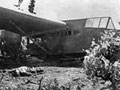
The invasion began on the morning of 20 May. Shortly after 8 a.m., the men of Creforce saw gliders in the sky overhead, quickly followed by the rumbling of an approaching air armada. Hundreds of planes lumbered through the sky, dropping German paratroops into the area around Maleme and the township of Canea. Later in the day, paratroops dropped into the area around the airfields at Retimo and Heraklion.
German casualties mounted quickly. Many paratroops died before they could reach the ground; others were mown down after landing as they struggled to release themselves from their parachutes. Despite heavy losses, enough troops landed safely to secure tenuous footholds west of Maleme (an area mistakenly left unguarded by Freyberg) and in the Prison Valley, south-west of Canea.
By the end of the day German forces around Maleme, Retimo and Heraklion had failed to secure any of their objectives. Their commanders in Athens feared the operation was a failure and the prospect of a humiliating defeat loomed. It was decided to throw all available resources into an attack on Maleme the next day. Securing the airfield was the key to the success of the invasion; without it, reinforcements could not be sent in.
German victory
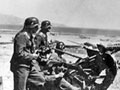
The decision to concentrate on Maleme paid off for the Germans. On the morning of 21 May it became clear that the New Zealand infantry battalions defending the airfield and the key high ground overlooking it had withdrawn. This crucial mistake effectively sealed the fate of Creforce. Although the airfield was still under artillery fire, the Germans wasted no time flying in reinforcements which tipped the balance of the battle in their favour.
The cost of battle
More than 1700 British, Commonwealth and Greek soldiers were killed and 15,000 captured during the Battle for Crete. There were 671 New Zealanders among the dead, and 2180 Kiwi prisoners of war. More than 6000 Germans were killed or wounded. The Luftwaffe lost more than 350 aircraft.
Fresh troop reinforcements and the dominance of the Luftwaffe (German air force) above Crete left the defenders facing impossible odds. After six days of hard fighting Freyberg received the order to evacuate his weary forces. Parts of Creforce pulled back to Sfakia on the south coast, and from here about 10,500 troops left the island over four nights. A separate evacuation at Heraklion rescued a further 6000 soldiers, although a number of these men were killed by air attacks on their ships during the return journey to Egypt.
The soldiers left behind – around 6500 – formally surrendered to the Germans on 1 June. The majority would spend the rest of the war in prisoner of war camps – initiallly in Italy and later in Germany and Poland. Others took to the hills, some later escaping to Egypt by submarine or fishing boat. With the help of Cretan civilians, a handful of men eluded capture on the island for years and took part in resistance fighting.


