
Life for the New Zealand soldier on Gallipoli was tough. Packed inside the tiny Anzac perimeter, they endured extreme weather and primitive living conditions during their eight-odd months on the peninsula. During summer (June-August), temperatures soared, while the winter months (November-January) brought rain, snow and bone-chilling winds. After a few months in crowded conditions on the peninsula, soldiers began to come down with dysentery and typhoid because of inadequate sanitation, unburied bodies and swarms of flies. Poor food, water shortages and exhaustion reduced the men’s resistance to disease.
Living conditions
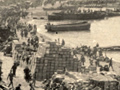
The area occupied by the New Zealanders and Australians at Anzac was tiny – less than six square kilometres. At its furthest point, the distance between the front line and the beach was just over 900 metres. Conditions were harsh. The area possessed no natural water source, so there were constant shortages. Water, food, ammunition, and other supplies arrived at Anzac on ships and were landed on the beach with great difficulty.
Whenever possible, whether in the line or out of it, a man paired off with a mate and established a ‘bivvy’. This was a structure of a very primitive sort. With pick and shovel a cut was made in a slope that gave protection from the bullets of the snipers, and if possible from the bursts of shrapnel. A couple of salvaged oil sheets pinned across with salvaged bayonets made a roof that would keep out the dew at night and the sun glare by day. Furnishings consisted of commandeered sandbags or old overcoats for softening the hardness of the baked floor, a cut down petrol tin for a ‘bath’ and whole one for storing water. As soon as the work was finished the flies and the lice – the permanent residents – took up their abode, while the casual boarders such as centipedes and soldiers strayed in from time to time as opportunity offered…
Ormond Burton, The Silent Division, 1935
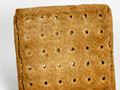
Poor food contributed to a general deterioration in the men’s health. Troops lived on a staple diet of tinned bully beef, army biscuits and jam; fresh fruit and vegetables were non-existent. Sanitation was also a problem. With up to 25,000 men packed into such a cramped space, latrines filled up fast and there was limited space for new ones. Body lice became endemic, and diseases like diarrhoea, dysentery and enteric fever (typhoid) flourished in the unsanitary conditions.
Bully beef and biscuits. You couldn’t eat your biscuit dry. It was like chewing rock. You’d break your teeth in the biscuits if you got stuck into them. You had to soak it. For pudding we used to have biscuit soaking in water and the jam all mixed up together. They issued you with a small tin of jam, perhaps four to a tin.
Russell Weir, Wellington Battalion, in Jane Tolerton, An Awfully Big Adventure: New Zealand World War One veterans tell their stories, 2013
The stench of the dead made living conditions even worse. Unburied corpses littered no man’s land, while others lay in shallow graves close to the dugouts of the living. In the searing heat of summer, the rotting corpses, food and body waste were the perfect breeding ground for flies and the diseases they spread. Swarms of flies tormented the men, turning simple tasks such as preparing and eating food into horrible ordeals.
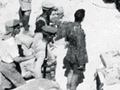
Psychological pressures magnified the physical hardships. Service in the front line was always dangerous. Opposing trenches were extremely close – barely four metres apart in some places. At this range, enemy hand grenades, or ‘bombs’, caused a steady stream of casualties. Danger also lurked behind the front line. No place within the tiny perimeter was safe from enemy fire, and Ottoman shells and snipers took a toll of troops in support areas.
Medical treatment
For those wounded on Gallipoli, the wait for treatment and evacuation was often long and agonising. Compared with the organisation and efficiency of the Western Front, medical services at Gallipoli were a shambles. The evacuation framework for casualties — moving wounded from field ambulances to casualty clearing stations, and then military hospitals — fell apart, as poor planning and the sheer scale of casualties overwhelmed the available medical resources.
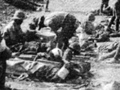
During the April landings and the August offensive, the advanced dressing stations in the gullies and the casualty clearing stations on the beach could not cope with the large numbers of wounded. The stations themselves often came under fire because of their exposed positions.
From the field ambulances and casualty clearing stations, wounded were evacuated by boat to hospital ships and ambulance transports — dubbed ‘black ships’ — waiting offshore. Poor coordination and mismanagement meant that many serious cases were left on the beach too long; once on board they found appalling conditions.
...There were no beds. Some were still on stretchers on which they had been carried down from the hills, some on the paillasses thrown down on the hard decks. The few Red Cross orderlies were terribly overworked. For twelve hours on end an orderly would be alone with sixty desperately wounded men in a hold dimly lit by one arc lamp. None of them had been washed and many were still in their torn and blood-stained uniforms. There were bandages that had not been touched for two or three days – and men who lay in an indescribable mess of blood and filth … Most of them were in great pain, many could get no ease or rest, and all were patched with thirst. Those who slept dreamed troubled dreams and those waked were in torment:
‘Orderly! Orderly! Water! Water!
‘Orderly, for Christ’s sake, ease me up a little.’
‘Orderly! I can’t sleep.’
‘Water! Fetch me a drink.’
‘Oh God! Oh God! Oh God!’
‘I can’t sleep. I haven’t slept for three nights – give me morphia.’
‘Oh God! You don’t know how this hurts.’
‘Oh thank you orderly, but can’t you give me a whole cupful.’
‘Orderly! Orderly! Fetch me a drink.’
‘Look out there! They are coming! Take that you bastard!’
‘Oh God! Oh God! – the pain!’Ormond Burton, New Zealand Medical Corps, quoted in Gavin McLean, Ian McGibbon & Kynan Gentry, The Penguin Book of New Zealanders at War, 2009
The ships transported wounded to hospitals in Egypt, Lemnos, Malta or even to England. Such was the chaos of the operation that some relatively lightly wounded men ended up in England, while casualties still convalescing found themselves going back to Gallipoli.
Uniform and equipment
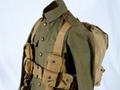
New Zealand troops came ashore at Anzac on 25 April 1915 laden with equipment. Infantrymen carried a rifle, ammunition, bayonet, water bottle, entrenching tool, haversack, and a pack containing over 30 kilograms of extra rations, water, firewood and clothing. Individual food rations, known as ‘iron rations’, consisted of tinned bully beef, hard biscuits, tea, sugar and beef cubes. Soldiers attached most of this kit to webbing, which they wore over their uniforms.
The majority of New Zealanders on Gallipoli wore Territorial Force uniforms introduced in 1912. These were a darker shade of green than the khaki-brown British uniforms, and featured coloured piping on the epaulettes to distinguish branches of service.
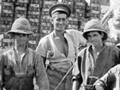
As the campaign dragged onto in summer, comfort and practicality became more important to the Anzacs than maintaining dress regulations and appearance. Soldiers stitched bits of cloth to the back of their peaked ‘forage caps’ for better sun protection, rolled up or cut off shirtsleeves, and turned trousers into shorts. Most kept their hair short as protection against lice but water shortages meant that shaving was a luxury.
Day by day the sun grew hotter and hotter until it burned down scorchingly hot. There was scarcely any shade. The bivvies themselves were swelteringly hot. The ground was almost red hot. There was little stirring of air beneath the great cliffs. Men soon commenced to shed their clothing. Slacks were ripped off at the knees and the vogue of shorts commenced. Coats were flung off and then shirts. The ‘Tommy hats’ in which the New Zealanders had landed were soon thrown away and replaced by Australian felts, pith helmets or the New Zealand issue of unfortunate members of the reinforcement drafts … Within six weeks of landing the fashionable costume had become boots, shorts, identity disk, hat and when circumstances permitted a cheerful smile. The whole was topped off by a most glorious coat of sunburn.
Ormond Burton, The Silent Division, 1935
Most New Zealand infantrymen were armed with .303-inch ‘Long’ Magazine Lee Enfield Mk I rifles. The exceptions were officers (who carried revolvers), and specialist personnel like machine gunners. They operated .303 MK III Maxim Guns – the standard heavy machine gun used by the NZEF in 1914-15. It fired up to 400 rounds per minute, and proved vital to the defence of the Anzac perimeter.


