
The troops arrive
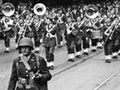
For Aucklanders, the ‘invasion’ began on 12 June 1942. The skies were grey and the water the colour of steel as five transport ships, with a cruiser in front and a destroyer in the rear, sailed into Waitematā Harbour unannounced. Next morning the Mayor of Auckland, J.A.C. Allum, and four military bands stood on Prince’s Wharf waiting to greet the new arrivals. They played appropriate pieces – ‘The Stars and Stripes forever’; ‘Colonel Bogey’ – and were quickly answered by sousaphones on board ship playing ‘Roll out the barrel’. Ferries blasted their horns, passengers waved; the Americans – nurses in blue, soldiers in olive-green – cheered and crammed the city-facing side of one transport so tightly that the ship listed heavily.
As the ships berthed, another exchange occurred. The Americans threw down oranges, cigarettes and money; the waiting Kiwis pocketed the gifts and threw back New Zealand coins. When some of the visitors wondered where they were, an American on the wharf, one of the advance guard, told them all they needed to know: ‘No Scotch, two per cent beer, but nice folks’. Some evidently did know what country they had reached, for the first of the newcomers to land on New Zealand soil was Sergeant Nathan E. Cook, chosen as a namesake of the explorer James Cook. It was some hours before all his comrades of the 145th Regiment, 37th Infantry Division were marched off to the railway station and on to camp.
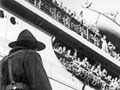
Wellington’s invasion began the following days, 14 June 1942, when a battered USS Wakefield entered the harbour. It was a Sunday morning and there were few people about, but again there was a band waiting on King’s Wharf. This played the Marine Corps hymn, ‘From the halls of Montezuma, to the shores of Tripoli’, for these arrivals were the 1st Marine Division. The distinction – army units to Auckland, Marines to Wellington – was to remain largely the pattern as Americans, women as well as men, arrived over the next two years.
Why did they come?
It was the dramatic outbreak of war in the Pacific six months earlier which had brought about the first substantial landing in New Zealand of overseas troops since British regiments in the 1860s.
On 7 December 1941, Japanese bombers crippled the American Pacific fleet at Pearl Harbor in Honolulu. If New Zealanders felt thankful that the Americans were now involved in the war, their confidence was quickly shaken. Within days the Royal Navy, for so long New Zealand’s surest bastion, was shown to be vulnerable when the warships HMS Prince of Wales and HMS Repulse were sunk by Japanese torpedoes. By Christmas Day Hong Kong had fallen, and on 15 February 1942 Singapore surrendered. Four days later, more than 250 people were killed when Darwin was bombed. Some New Zealanders feared that Auckland might be next.
Looking to the US
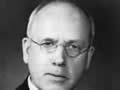
The prime minister, Peter Fraser, appealed to British Prime Minister Winston Churchill for assistance in strengthening New Zealand’s defences. Churchill was sympathetic but in no position to help. The obvious option was to emulate Australia and withdraw the 2nd New Zealand Division from the Middle East to defend the homeland. But the war in the Middle East was delicately balanced, and the New Zealand troops had been trained to fight there. To withdraw them would be time-consuming and costly in terms of shipping. On 5 March 1942, Churchill asked US President Franklin D. Roosevelt to send a division to New Zealand on the condition that the New Zealanders remained in Egypt. Roosevelt agreed, and on 24 March cabled that ‘we are straining every effort’ to send forces as soon as possible.
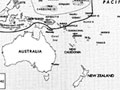
From the American perspective, New Zealand had strategic importance. In mid-March the Allies had decided to divide responsibility for their forces into three zones. The British would control the Middle East–Indian Ocean area, the European–Atlantic zone would be a shared responsibility, and the Pacific would come under the US Joint Chiefs of Staff. The Pacific was divided into two main theatres: the South-west Pacific – including Australia, the Philippines, New Guinea and the Dutch East Indies (Indonesia) – and the Pacific Ocean, in which New Zealand was a main base.
New Zealand would serve as a source of supply and a staging post for operations against the Japanese in the Pacific. American forces could train there for offensives ahead or recuperate from battles just past. New Zealand could also provide vegetables and stores for the forces at the front.


