
Servicing the military machine

Individual leathernecks and doughboys were not the only customers for cash-strapped Kiwis. The American military machine placed large demands on the New Zealand economy. The construction of the camps gave work, often under great pressure of time, to carpenters, plumbers and electricians. The administration of the bases gave jobs to typists, ‘office girls’ and women drivers. Then there were those who found work repairing jeeps, trucks, tanks and other machinery.
Shipbuilding was another industry which received an unexpected boost with a brief period of plentiful overtime and higher pay. Much of this work was paid for by the New Zealand government under a reverse lend-lease arrangement (the provision of supplies to the Americans in return for their supply of war material to New Zealand).
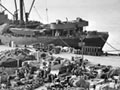
The wharves were the ‘front line’ of the invasion. All the equipment for the camps passed across them; more importantly, New Zealand functioned as a supply base for Pacific operations. Ships from overseas or elsewhere in New Zealand had to be unloaded, the stores organised and then despatched to the appropriate Pacific theatre. However, relations on the wharf started off on the wrong foot: when the first group of Marines arrived to prepare for the Guadalcanal landings, an industrial dispute was in progress and they had to do the work themselves at speed in cold Wellington rain.
In Auckland, waterside work increased so much that non-union labour was employed, and public servants and other 40-hour-week workers were offered work at night and on weekends. This overtime work was, in comparative terms, extremely generously paid, and for a time in 1943 many civilian employees were turning up to their day jobs exhausted after lucrative night work on the wharves.
An army marches on its stomach
New Zealand was a major supply base for the American forces in the Pacific; 36% of all food received by American troops in the South Pacific came from this country. But farmers were already under pressure to produce for both the local market and the British ‘motherland’.
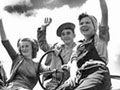
Canned meats were produced in large volume, as were potatoes. After some experimentation farmers discovered that they would receive more for their efforts by growing cabbages, the acreage of which multiplied to such an extent that eventually the Americans revolted and dumped large quantities at sea. In other respects the farming programme worked well; at times the Americans assisted in the effort by offering their labour to local market gardeners, which gave the ‘land girls’ working there ‘an added thrill’, as the New Zealand Woman’s Weekly put it.
Inevitably, a force the size of the Americans caused other economic tensions and distortions. As offices and accommodation were taken over in Wellington and Auckland, rents rose and the housing shortage intensified. At Christmas some New Zealanders grumbled when they found that there was not a turkey to be had. But these were no worse than the multitude of other distortions which war had brought; and, after a decade in which New Zealanders had had too few jobs and there had been too little economic demand, the presence of thousands of Americans with money to spend was an unexpected bonanza.
Separating servicemen from their money
The American serviceman was prepared to spend money. He was well paid, often arrived with back pay, and wanted to have a good time fast. He found the prices and coinage confusing, and it was not hard to separate him from his money. At a time of rigid control and restraint in the domestic economy, here was an opportunity too good to miss. The result was a minor economic boom which also had long-term effects on local habits and patterns of commerce.
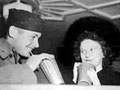
Some existing businesses suddenly found themselves in great demand. Certain pubs did well, as did well-positioned cinemas. Dry-cleaners welcomed new custom; so did florists and taxi drivers. Curio shops found their stock suddenly depleted. In Wellington, the French Maid coffee shop gained a new circle of customers, as did the Green Parrot restaurant. Eating places adapted their menus. ‘Steak and chips’ became a favourite, while hot dogs and milk shakes were introduced.
New businesses also sprang up. Hollywood culture was so pervasive by 1942 that milk bars already existed, but the coming of the Americans hastened their spread. By 1943 the Manners St area of Wellington was home to the Kiwi Milk Bar, the Pacific Grill Rooms, Webby’s Dance Club and the Gaiety Club, all newly on the scene. Children exploited an opportunity by offering Marines shoeshines and pestering them for tips or gifts of candy bars. At the end of 1942 Wellington city banned shoeshine boys from its streets.
The invasion had an impact on patterns of commerce in New Zealand. Tipping – previously unknown – rapidly appeared. Commercial opportunities and apprehension about servicemen walking aimlessly in the streets led to a questioning of the traditional Sunday close-down. Gradually the towns around the camps opened grill rooms, milk bars and even cinemas on the Sabbath. Monetary inducements were such that habits of honesty came under threat. Liquor dealers found themselves trading after hours; taxi drivers were tempted to overcharge unsuspecting Americans.


