
In 1942 the Battle of the Coral Sea (7-8 May) and Battle of Midway (3-6 June) between the Japanese and United States navies left the United States with superior numbers of essential aircraft carriers. Japan had lost the initiative. This set the stage for New Zealand's involvement in the American campaign in the Solomon Islands — the closest point to home where the New Zealanders fought.
Japanese attack
'It was dense jungle and all that was left were a few shattered stumps. The rest of it was like a ploughed field from all the shell bursts. There was equipment everywhere, spent cartridges, rifles. Debris everywhere. It was frightening. The smell of death. The Americans had bulldozed great big holes and pushed all the corpses in and put in quicklime in the front line, but up in the hills you couldn't do that and there were arms and legs and limbs sticking out everywhere. The smell. Dead bodies.
When we came back from that front line we couldn't eat our lunch. The smell of dead bodies in the tropics is something else. It's something you can't get rid of. It was upsetting.'
Bill Mitchell 391789, who was a corporal in the RNZAF, describes the aftermath of a Japanese attack on Piva airstrip, Bougainville, Solomon Islands in 1944
New Zealand seamen were the first involved. The ships Leander and Achilles joined American naval forces near Guadalcanal; Leander was later torpedoed and had to return to New Zealand. Then airmen from 3 Squadron arrived at Henderson Field on Guadalcanal in November 1942, and more New Zealand squadrons arrived over the next months.
3 Division
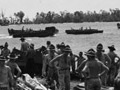
New Zealand's 2 Division remained in the European theatre, but 3 Division was training to go to 'the islands'. In November 1942 New Zealand troops began arriving in New Caledonia and then were sent to Guadalcanal, arriving there in August 1943. The men were shocked at the appearance of the island. Intense shelling had stripped trees of their leaves and snapped their trunks. Bodies of Japanese and United States troops were buried in makeshift graves.
In September 1943 14 Brigade took over from the Americans on the island of Vella Lavella, and experienced the rigours of jungle warfare for the first time. They were in danger of being shot by Japanese snipers or being cut down in an ambush.
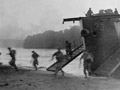
The following month, New Zealanders landed on Mono Island. This was the first opposed amphibious landing by New Zealand forces since Gallipoli. They successfully took the island from the Japanese defenders. Early in the following year the New Zealanders attacked Nissan in the Green Islands to the north of Bougainville. An airbase was quickly built on the island which fighter-bomber squadrons used to attack Rabaul.
The men of 3 Division returned to New Zealand in August 1944. The New Zealand government was finding it difficult to sustain the forces in Europe, and extra labour was needed on farms. Some of the men from 3 Division were sent to Italy and the Middle East; others were directed to work in factories or on farms.


