
'Rewi's last stand'
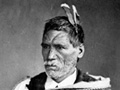
Following the battle at Hairini on 22 February 1864, Rewi Maniapoto moved a few kilometres south to the vicinity of the Pūniu River. In March Tūhoe and Ngāti Raukawa fighters arrived from the east to bolster the Ngāti Maniapoto force. Having missed the earlier action, they were determined to fight.
Tūhoe and Ngāti Raukawa pleaded with Rewi to give them Ōrākau, east of Kihikihi near the Pūniu, ‘as a place to use our guns and ammunition. They are too heavy to carry all this way for nothing.’ Rewi did not want to fight, especially at this location. ‘Only by not fighting may I retain my lands … do not fight at Orakau’. He warned that ‘if you Tuhoe persist in your desire for battle, I alone will be the survivor’. Rewi’s pleas fell on deaf ears. Many of his supporters joined Tūhoe and Ngāti Raukawa in urging him to make a stand. After playing for time by suggesting consultation with Wiremu Tāmihana at Maungatautari, Rewi relented. He would fight at Ōrākau.
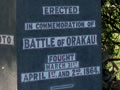
‘Rewi’s last stand’ at Ōrākau between 31 March and 2 April 1864 was immortalised in Rudall Hayward’s 1925 silent film (remade as a ‘talkie’ in 1940) of that name. The movie was clearly influenced by cinematic representations of the American West.
A stand in a peach grove
Rewi’s men began building a redoubt-shaped pa at Ōrākau in late March 1864. The British stationed at Kihikihi soon observed this development. Brigadier-General G.J. Carey sent an armed force under Majors von Tempsky and Blyth to investigate. Within two days more than 1400 troops had arrived at Ōrākau, where the fortification was still incomplete. With the arrival of some Waikato reinforcements the number of defenders was about 300 – up to a third of them women.
Though it is associated with Rewi in popular memory, the principal architect of Ōrākau’s defences was Ngāti Raukawa chief Te Paerata. While it was easily fortified, the site in a peach grove lacked both an adequate water supply and an obvious escape route. Rewi’s fear that it could easily be surrounded was also to be confirmed.
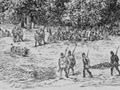
As the British advance began, Rewi told his men to hold their fire until the troops reached the fence around the peach grove. The soldiers marched four abreast until they were ordered to charge. By the time Rewi gave the order to fire they were less than 50 m from the pā. A volley from the parapet stemmed the advance. The troops fell back, reformed, and renewed their attack. When they were hit by another volley, their officers decided to surround rather than assault the position.
Steady fire prevented Māori reinforcements from reaching Ōrākau. Unable to get to the pā, they sat ‘on the hill and wept their farewell, for they thought that … none (would) escape’. Lieutenant-General Cameron arrived on 2 April with reinforcements that increased the British strength to more than 1400. By now almost out of food, water and ammunition, the occupants of the pā were becoming desperate.
‘Friend, I shall fight against you, forever, forever!’
The defenders were offered a last chance to surrender. This demand was met with a famous reply, one version of which is:
E hoa, ka whawhai tonu mātou, Āke! Āke! Āke!
Friend, we will fight on forever, forever and forever!
Some attribute these words to Rewi. Others believe they were uttered by Hauraki Tonganui, a Taupō chief. Whoever spoke, the intent of the defenders was clear. This helped foster the idea that Ōrākau was a historic ‘last stand’ for Māori.
To a suggestion that the women be allowed to leave the pa, Te Paerata’s daughter Ahumai replied: ‘Ki te mate ngā tāne, me mate anō ngā wāhine me ngā tamariki’ – ‘If the men die, the women and children must die also.’ Though two more assaults were beaten back, it was obvious that the defenders could not hold out for much longer.
At 3.30 p.m. nearly all the Māori left the pā in a disciplined body. This move in broad daylight caught the British by surprise and the Māori broke through the surrounding cordon. The fugitives then split into small groups that were pursued by cavalry and Forest Rangers across 3 km of open country to the Pūniu River. It was during this retreat that most of the Māori casualties occurred. Hitiri te Paerata described the ‘storm of bullets’ that killed his father, brothers and uncle and wounded his sister, Ahumai.
Chris Pugsley estimates that at least 160 of the pā’s occupants were killed, with women bayoneted as they lay wounded. Interpreter William Mair expressed his ‘disgust at the generally obscene and profane behaviour of the troops’. Attempts to justify these actions by claiming the women had dressed like men convinced few. British casualties over the three days of fighting were 17 dead and 50 wounded.
A new aukati
James Belich argues that the British victory at Ōrākau was also their ‘cruellest disappointment of the entire war’. The King Movement still existed as an independent entity, albeit in Ngāti Maniapoto land south of the Puniu River, the new aukati.
Pugsley, on the other hand, sees Ōrākau as the ‘decisive victory that Cameron had sought’. The war north of the Pūniu was now over, but a fourth line of defence was prepared beyond the aukati. Tāmihana and Rewi Maniapoto warned British envoys that ‘if the Pākehā attempted to carry on the war in any district beyond the boundary they would fight again’.
The British did not attack. Instead, they turned their attention eastwards to Tauranga and Bay of Plenty, a region through which reinforcements and supplies had flowed to the Kīngitanga.


