
On 2 April 1846, Andrew Gillespie and his young son were attacked and killed by Ngāti Rangatahi. The Gillespies had been attempting to farm some of the land from which Ngāti Rangatahi had been recently evicted. Settlers in outlying areas moved into town as Wellington prepared for war.
By May Te Rangihaeata was regarded as ‘being in arms against the government’. Although he had played little or no part in the recent unrest, it was widely believed that Kāparatehau and others were fighting on his orders. Grey placated Ngāti Tama and Ngāti Rangatahi with a grant of 300 acres (121 ha) at Kaiwharawhara on the western side of the harbour and monetary compensation for any crops lost. Te Kāeaea was ‘sent on a visit to Auckland'.
Boulcott's Farm
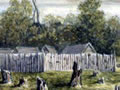
The most advanced British post in Hutt Valley was now at Boulcott’s Farm, about 20 km from Wellington. It was defended by 50 men of the 58th Regiment under the command of Lieutenant G.H. Page. The barn at the centre of the farm’s defences was surrounded by a loopholed stockade.
An attack on Boulcott’s Farm at dawn on 16 May 1846 left six soldiers dead and two mortally wounded. The attack was led by Te Mamaku of Ngāti Hāua-te-rangi, who had recently brought 200 fighters from Whanganui to support his Ngāti Rangatahi kin and Te Rangihaeata.

Te Mamaku’s men had camouflaged themselves with pieces of brush. A sentry noticed that some of the brush surrounding the stockade was moving and fired into it. He was quickly overwhelmed and killed. Then Private William Allen was struck down while attempting to sound the alarm. His efforts to warn his comrades made him a hero in colonial society, but the attack further demoralised the settler community.
A month later an armed patrol in the same area was ambushed and four men were wounded. Te Mamaku withdrew to Whanganui and sought the assistance of local chiefs. His letters were intercepted and Richard Taylor passed one of them on to the government. Grey now devised a strategy to deal with the Ngāti Toa threat.

