
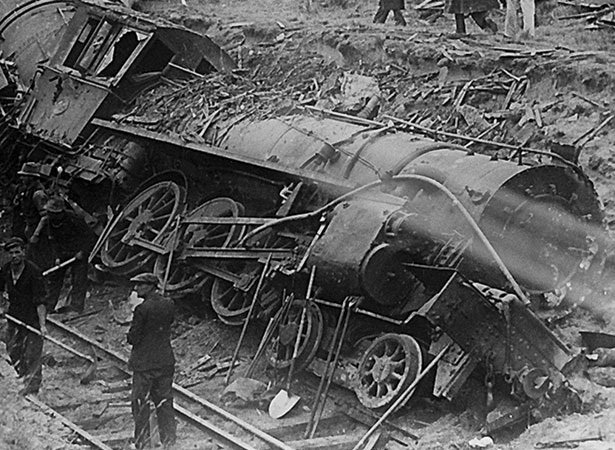
The Cromwell–Dunedin express, travelling at speed, derailed while rounding a curve near Hyde in Central Otago. Twenty-one of the 113 passengers on board were killed and 47 injured in what was then New Zealand’s worst rail accident.
When locomotive Ab 782 left the rails at 1.45 p.m. all seven carriages followed. Four were telescoped together and several were smashed to pieces. The survivors did what they could for each other until help arrived 90 minutes later. Rescue work continued through the night.
A board of inquiry found the locomotive had entered the bend at perhaps 112 km per hour, more than twice the speed limit for that section of track. Engine driver John Corcoran was subsequently found guilty of manslaughter and sentenced to three years in prison. Some have argued that Corcoran, fatigued after working long hours, was a scapegoat for a Railways Department happy to absolve itself of any blame.
The Hyde derailment remains the second-worst rail disaster in New Zealand’s history – surpassed only by the 1953 Tangiwai tragedy (see 24 December).
Read more on NZHistory
New Zealand disasters timeline – New Zealand disasters timelineNew Zealand crime timeline – Crime timelineHyde railway disaster memorial – Otago memorials
External links
How to cite this page
'Rail tragedy at Hyde', URL: https://nzhistory.govt.nz/cromwell-dunedin-express-train-tragedy, (Ministry for Culture and Heritage), updated 20-Jan-2021


