
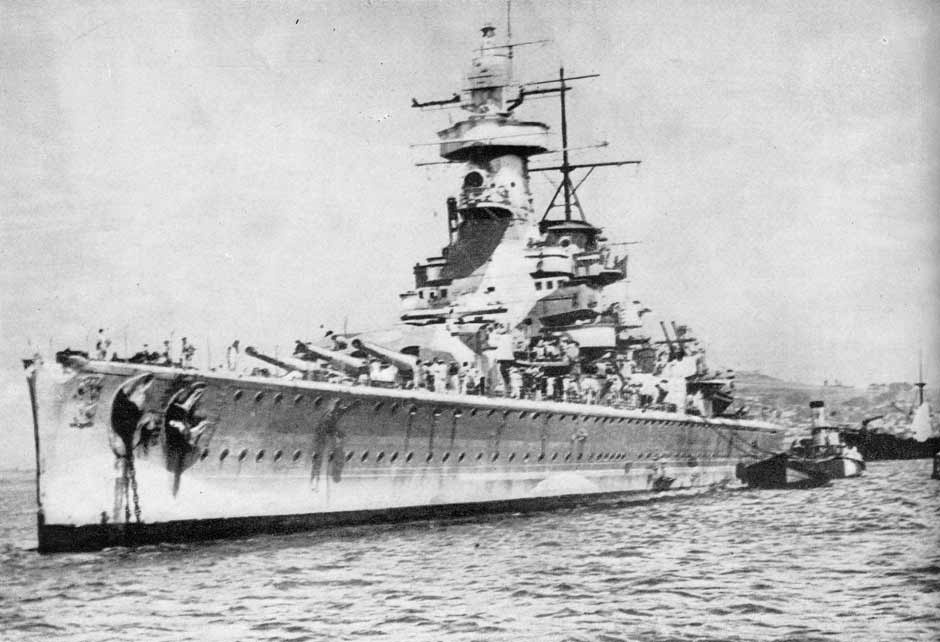
The Admiral Graf Spee photographed in Montevideo Harbour following the Battle of the River Plate. A shell-hole is visible below the forward guns.
Initially Germany's interwar naval development had been constrained by the 1919 Treaty of Versailles, which imposed strict limits on the size and number of warships that it could commission. Restricted to a tonnage limit of 10,000 tons, the Germans responded by creating a class of armoured cruisers (Panzerschiffe). Although cruisers by tonnage, they carried heavier guns than existing cruisers. As a result the British dubbed them ‘pocket battleships'. Three were launched between 1931 and 1934: Deutschland, Admiral Scheer and Admiral Graf Spee.
Although nominally 10,000 tons, Admiral Graf Spee probably displaced 14,000 tons (the Germans cheated on the Versailles limits). It was much larger than the British heavy cruisers (about 8000 tons) and outgunned them too. Whereas a British heavy cruiser had 8-inch (203 mm) guns, Graf Spee boasted six 11-inch (280 mm) guns in two triple turrets, capable of throwing 300-kilogram shells more than 30 kilometres. As secondary armament, it had eight 5.9-inch (150 mm) guns and eight 21-inch (533 mm) torpedo tubes, and it carried two seaplanes. It was capable of 28 knots at full power of its diesel engines.


Community contributions